
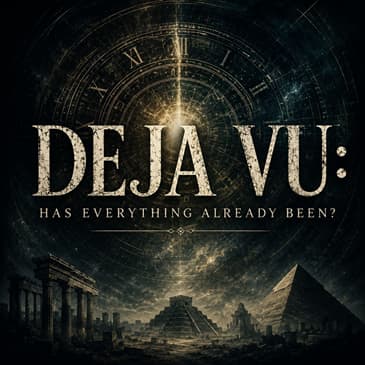
What if human history stretches back much further than we've been taught?
In this episode, Brandon sits down with Polish researcher and author Alexander Czeskiewicz to discuss ancient civilizations, Atlantis, cyclical time, and the possibility that humanity has risen and fallen more than once throughout history.
Alexander explains why he believes mainstream history only scratches the surface of our true past, exploring evidence from ancient Egypt, Sumer, Göbekli Tepe, flood myths, and megalithic structures around the world. The conversation also dives into the Great Pyramid, Atlantis, the Younger Dryas, the origins of civilization, simulation theory, and whether humanity has been guided by higher intelligences throughout history.
Could the myths passed down through thousands of years actually preserve memories of a forgotten civilization? Are recurring symbols, sacred numbers, and ancient stories pointing toward a hidden pattern woven into reality itself?
Whether you view these ideas as history, philosophy, or speculation, this discussion challenges conventional thinking and invites listeners to question what they know about the origins of humanity.
Become a supporter of this podcast: https://www.spreaker.com/podcast/tinfoil-tales--6147818/support.
Want to be a Guest?
If you have a paranormal encounter, conspiracy theory, or unexplained story to share, we'd love to hear from you! Reach out to us at tinfoiltalespodcast@gmail.com or use the contact button on our website.
http://www.tinfoiltales.com
Let's schedule you for a future episode and dive into the mysteries together!
Got Weird Stuff?
Have some strange physical evidence you want to share?
Mail it to:
Tinfoil Tales
P.O. Box 302
Peru, IN 46970
📱 Follow Us on Social Media:
Stay engaged on Facebook to join the conversation.
http://www.facebook.com/tinfoiltales and look for Brandon Tinfoil Tales
Explore mysterious visuals on Instagram and share your own experiences.
https://www.instagram.com/tinfoiltalespodcast
📺 Subscribe to our YouTube Channel:
Hosted by Simplecast, an AdsWizz company. See pcm.adswizz.com for information about our collection and use of personal data for advertising.
[00:00:03] And I just turned around and I pulled ass out of there. I was done. I wasn't dealing with that. The hypocrisy of the cult is one of the things that turned me away the quickest. When I turned my headlights on, it turned and looked at us. And one of the things I remember the most were the eyes were glowing red.
[00:00:30] I see an orb of light. It is just circling these steps like it is waiting for me. And when he begins to tell them that he saw a UFO, they're basically like, what are you talking about? That's seven foot up on a tree, peeking around it. And that's where I saw the top of the muzzle, nose and the eyes.
[00:00:58] As soon as I made eye contact with this thing, it felt like death. Welcome back to Tinfoil Tales. Today I'm joined by my guest, Alexander. Thanks for coming on here and talking to me. Thanks for having me on. Would you like to let the audience know a little bit about yourself? My name is Alexander Cieszkiewicz. I'm a Polish researcher and author of Deja Vu Has Everything Already Been.
[00:01:25] It's my first book about lost civilizations, cyclical time. It's like full 400 pages, book with footnotes, bibliography, plenty of different kinds of topics. And I wrote it just when I was 17 years old. So lots of people say, wow, wow. But for me, it was just a casual thing.
[00:01:47] I had an idea. And my biggest main areas of knowledge are actually the biggest possible mysteries of the universe, of the past, like lost civilizations, Atlantis, cyclical time, physics, spirituality, metaphysics, and so on. What got you interested in all of that?
[00:02:12] What I was being taught at school and what I was reading in all of the textbooks, academic books wasn't just enough for me. I was asking more and more questions about the origins of humanity, civilizations. And I found out that what we know when it comes to the mainstream knowledge is actually almost nothing, just a fraction of what was possibly happening in the deepest, deepest antiquity and prehistory.
[00:02:41] So it wasn't enough for me. So I then went on to this route of alternative history, conspiracy theories, but also what our ancient ancestors directly told us about the origins of humanity, the origins of civilizations, etc. So that was this way. Well, if you would like to share some of the things you come across and what you've learned, I'd love to hear about it.
[00:03:10] Yes, I think that the first questions that I started asking, if I was learning at biology, that anatomically modern humans just as we today with slight minor changes appeared about 200,000 years ago. And it was a few years ago. And it was a few years ago.
[00:03:27] Right now, scientists, even the mainstream ones are pushing the origins of humans, just as you and me, not like previous hominids to about half a million years ago, or even conservatively 300,000 years ago. I asked basic questions, what we were doing for all these hundreds of thousands of years if civilization appeared just about 5,000 to 6,000 years ago.
[00:03:53] What we were doing for this 95, 96, 98% of our existence. Could it be that there was something before the first civilization? Could it be that ancient Sumerians weren't the first at all, or Egyptians, or any other kind of first peoples we know from history? And I started digging deeper and deeper.
[00:04:12] And what I think it's the most interesting part from this, let's say, mainstream part of history is that most or almost all of the ancient people from the first considered by us first civilizations considered themselves not to be the first at all and considered themselves either to be, to be like their civilization to be much older than we are thinking right now from the mainstream perspective.
[00:04:42] Or that before there, there were previous civilizations and they are just descendants from these previous now lost civilizations. So I was shocked that all the most ancient peoples are telling us that they were not the first. And right now, a mainstream is telling us that these were the first people. So I thought it's a little bit suspicious for me. And I started digging deeper and deeper.
[00:05:09] And most of these people, like ancient Sumerians, ancient Egyptians, ancient Hindu people, had plenty of different texts, legends, but not only legends. Even, for instance, Sumerians, Egyptian kings list, that were telling us that before the first farias that we considered today to be the first or the first Sumerian rulers that we know were for us the first. There were plenty of others in that history is much, much older.
[00:05:37] And comparing that to this biological, genetic stuff about hundreds of thousands of years of the existence of anatomically modern humans, I found that it may be reality. It may be the history that is just lost nowadays. I think a lot of history is, for the most part, lost.
[00:06:01] I think a lot of stuff is, I don't want to say it's misleading, but I think there's a lot of things that is not necessarily known. And some of the stuff that is known is not widely accepted. So they only go back to what they can actually have the scientific quote unquote proof of. But like you said, I think there's civilizations that were around many years before that, but maybe they don't have enough evidence to conclude conclusively of that.
[00:06:32] Yes, I totally agree. That's why I start actually the first chapter of my book. It's about lost civilizations, lost history and stuff like that. But the first chapter is a little bit imaginative. I want to imagine what would happen if our modern, let's say, civilization, there would be some cataclysm, we would be wiped out, how the remnants of it would behave, how long would they last?
[00:06:57] And I'm comparing different kinds of modern day-to-day use materials, skyscrapers, even stuff that we send out to space. And it turns out that it wouldn't take that long for maybe not 100%, but let's say 90, 95% of the remnants of our modern civilization to vanish in, let's say, 10,000, 15,000 years or so.
[00:07:19] Maybe a little bit longer, maybe a little bit shorter, depending, of course, on what we are talking about, different materials, different kind of things we produce nowadays. So I think that, as you've said, most of the history is actually lost. And even when it comes to the mainstream view, we say, oh, the Sumerians were the earliest civilization about, let's say, 3,500 years BC.
[00:07:43] But actually, what I've learned even from the mainstream sources is that the ancient Sumerian civilization is like at least 1,000 or even 2,000 years older than that. But we consider it as a first civilization from the moment when they discovered, when they used in the first time, for the first time, writing script, any kind of writing system. And before that, there was at least 1,000 years of ancient Sumerian civilization.
[00:08:12] It was also almost the same big, you know, culturally unified, etc. But we are not considering this 1,000 years prior as a civilization because they didn't use a writing system. The same here in Eastern Europe, but I'm in Poland, but a little bit to east and south of me on the regions of Serbia and also of Ukraine and Romania, a few other countries.
[00:08:40] There are what are called proto-civilizations, pre-civilizations. And they were, interestingly, almost as big as ancient Sumerian because some of the cities found here in Eastern Europe that predate Sumerians by a few thousand years were as big as the known Sumerian cities. Like they had about 30,000 people at a single city, which is similar. Sumerian cities between 30 and let's say 60,000 people. At one time, of course.
[00:09:10] So we have pre-civilizations and why are we not talking about them and why we are not considering, oh, these people were 1,000 or 2,000 years before the Sumerians and they were having civilization already. We are not considering it because they didn't use any kind of writing system. Or maybe they use, but we don't have any evidence of. We have some signs that look like language, like letters, maybe something like that. But we cannot decipher it.
[00:09:40] So we cannot conclusively say this was a script, a written language used by them. So I agree with you that lots of the history is lost, actually, because of the basics like degradation, like not everything is being recorded. For instance, right now we are recording this podcast episode, but many thousands of years people were talking, having discussions, maybe even discovering, like talking to each other.
[00:10:08] Wonderful and, you know, new tech and highly advanced things. But it just wasn't recorded by anyone. So I agree with you on that. Do you, and I'm not trying to go off of anything else, but like, have you watched, I think it's been on Netflix where Graham Hancock's looked at other places. And I think it's over around maybe Indonesia or somewhere, but he thinks it's like at least 25,000 years old.
[00:10:35] I don't know how he's tested that or had any proof of that. But to me, 25,000 years ago is a lot longer than the five to 7,000 years that they've kind of related to us. Like that's an additional 20,000 years of history that's not being recorded.
[00:10:52] Yes, I know the site is called Gunun Padang in Indonesia, but there is a hidden debate because some people say it's a natural formation because it looks like some kind of rocks that are very symmetrical. They may look like being carved by humans that are piled up and looking similar to some kind of pyramid structure or a mound like the Native American mounds. But there is still a debate if it's natural or not.
[00:11:22] So I don't think it is such a great case, great idea because we still don't know. We haven't found like immediately tools or immediately direct and undoubtedly looking as human-like things there. So I think that's why it isn't such a great idea.
[00:11:41] But when it comes to pushing the boundaries of our history, as you've said, not 6,000 years, but 20-something thousand years, I was researching history as a science. History of history. So how historical discoveries were being made and how, let's say, our narrative about history was changing in the last few hundred years. What is interesting is right now we know, okay, let's say, Maitreuses, Sumerians are the first civilizations.
[00:12:10] But it wasn't until 1840s, less than 200 years ago. In 1840s, there started to be plenty of excavations on the area of the Middle East and they started finding first cities, entire cities, and then entire civilizations there. And before it was considered that Egyptians were the first civilizations and we knew almost nothing because right now we say, oh, Mesopotamia is a cradle of mankind, of civilization.
[00:12:38] And there were plenty of different civilizations, Sumerians, Babylonians, Assyrians, Akkadians, etc. But until 1840s, all of that was just mythology because we had sources about them. Even in the Bible, Abraham came from a Sumerian city of Ur, which we later found to be a real place. But scientists said, oh, these are just legends. We don't have any evidence that these places are real until 1840s, less than 200 years ago.
[00:13:06] And I think even in, let's say, next 100, next 50 years, we will, again, push the boundaries of civilization or of advanced human societies back by many thousands of years. I think the biggest mainstream one was the discovery in the late 90s of Gobekli Tepe. And, you know, these are this megalithic, similar to Stonehenge, but much more of them, like not a single circle or megalithic structures.
[00:13:36] Plenty of them and they have some carvings on them even and plenty of other place, things around them. And these are dated to at least 9600 BC, so 12,000 years ago. And who built them? Hunter-gatherers? This is the prevalent theory, but maybe it was some kind of advanced society. So I think even mainstream is pushing the dates back.
[00:13:59] If we find in, let's say, next few years, some kind of evidence that gunung padang in Indonesia, it may also be another milestone. Okay, it's 20,000 something years old and there was some kind of civilization. But again, we are talking about a few hundred thousand years of humans roaming the Earth, anatomically modern humans, not like hominids. So why not civilization 100,000 years ago? Why not 50,000 years ago?
[00:14:28] I see that it's within the possibilities, but we just haven't discovered, of course, all of that. We haven't dug the entire Earth. And lots of skeptics say because when it comes to Graham Hancock or any other kind of people searching for those civilizations, they are searching them in remote areas like Sahara, like Amazon rainforest, like Indonesia, etc.
[00:14:52] And skeptics say, oh, they are searching in these places because there are no evidence, according to skeptics, of previous civilizations, lost civilizations. So they are searching them there because it's hard to search the Sahara Desert or it's hard to search in the Amazon rainforest. Recently, they found with plenty of LIDAR scans that there is something there.
[00:15:14] And if we dug it up, we can possibly date that where it was existent, if it was an advanced civilization or not. But it isn't that researchers and explorers want to hide the evidence, etc. But it's just the fact that from, let's say, approximately 9,000, 10,000 BC and before, there were plenty of ice ages for tens of thousands of years.
[00:15:41] And ice ages mean that there were ice caps on the northern and on the southern part of the world much further than nowadays. For instance, most of Europe was under ice sheets. Here in Poland, where I live, more than half of Poland and half of Europe too was under ice sheets. So we cannot search for lost civilizations there because for tens of thousands of years, there were huge ice caps.
[00:16:06] Right now, we are also not building civilization on the glaciers in Antarctica or something. Only like small, scientifically oriented settlements, etc. So I think that's the view of how it looks like when it comes to searching for lost history. If we all came, I think the notion and belief for most mainstream sciences is human civilizations originated from the African continent.
[00:16:35] And then we dispersed from there. It doesn't always take into account just the amount of traveling throughout Europe over into the ice sheets up through Alaska down into the Americas. And then you got South America. That is a whole lot of migration from around an entire continent. And I get like, if we look at things in the spectrum of, well, this was within like 10,000 years. Sure.
[00:17:04] But that's still a big, broad range of spreading out in a small amount of time. It doesn't really make a whole lot of sense why a new species of civilization, not even civilization, but a few species of human would start to just continue to migrate. Hunter gatherer, they kept migrating. And they say, oh, they're hunter gatherers. So they're following the food.
[00:17:28] But if you look at the areas that they came from, Africa should have had plenty of food at that point, especially if there's during the ice ages. So why are they traveling through the ice to go and find other places to live? To me, that doesn't always make a whole lot of sense. Yeah, that's also, I think, very, very suspicious. As you've said, traveling to the places where there is ice, it's cold, it's hard for, you know, people or even home units, let's say, before us are not adapted if they truly evolved in Africa.
[00:17:57] Because they're adapted to much more sunnier and warmer climate and not going to these, you know, ice cold lands. I agree with that. We have evidence that there were migrations even before our species, even home units before us, homo habilis, etc. Traveled to Europe, etc. Maybe not that far. But I think it's the fact that, let's say, there were literally plenty of us back then.
[00:18:25] Let's assume that it's a rightful notion, as scientists say. And let's say just a few, let's say, outcasts or maybe people interested with determination. Okay, I will go there. We're traveling, traveling. And then they, that's why we have, let's say, people in Americas or in the Far East, Asia, etc. Because maybe it was like 1% of all the people. 90% said, no, we are not going forward into this icy land.
[00:18:53] Because we have some evidence that they migrated. Maybe there was like some kind of idea why they migrated. Maybe not. Maybe just as I said, oh, these are just, maybe even some kind of, some stupid people. Okay, let's go there. And okay, it's not a good climate. And they survived. And that's how they created then the populations in these regions. So I don't know for sure. But I know that some of these migrations were debunked.
[00:19:19] For instance, we thought before, even like 40, 50 years ago, that humans came to America, like 12,000 BC or something through, as you've said, the bridge from Asia to the Americas. But we found remnants of earlier humans, like tens of thousands of years earlier than that, already in America. So it's a great discussion.
[00:19:45] It was this Clovis first step that Graham Hancock also is talking about at academia for many years, still in textbooks. Textbooks was telling people, okay, they went, let's say, approximately 12,000 years ago into the Americas. But there were already people there before that. So it's a huge controversial question, idea. And I think we don't know much because I was studying a bit about, you know, anthropology,
[00:20:14] about ancient cultures, hominids, et cetera. And for many of these hominids that we know, like Australopithecus, Homo habilis, Homo erectus, et cetera, we have found only a few skeletons of them. So let's say there is a hominid we know, and we found like nine skeletons of them, not more. And it wasn't that nine full skeletons and we can reconstruct them. No.
[00:20:37] So let's say one was 10% of the bones, one was 20% of the bones, and the rest is just our interpretation, some kind of imagination, a little bit of, let's say, technical thinking about how they could have looked like, how they could have acted, et cetera. So I think we're still, even the mainstream, and I think people should know more about it, that when it comes to such like tens of thousands, hundreds of thousands of years, millions of years ago,
[00:21:06] we do not have much evidence for what was happening back then. And lots of stuff is just hypothesis. And maybe it was completely different than we are thinking right now about, oh, out of Africa, and then it spread everywhere. Maybe it was a little bit different, or maybe we will never know because the remnants just, degraded, eroded away, and are not there anymore.
[00:21:29] I've always kind of thought it was weird in a sense that some of these civilizations are spread apart. Like you have the Egyptians, and they were focused on building a pyramid. But then over here in South America, you had the people building the pyramids down around, like the Aztecs were building, and the Mayans were building their pyramids. And then I think there's some over, they believe maybe over around in China,
[00:21:55] there's just random spots where they have these type of buildings that they were doing out of stone that are almost like pyramids. But how did they all know and evolve to the point to know how to do stuff like that so far apart? They had no way of communicating with each other, but they evolved and all had the same idea that we're going to start building pyramid-type stuff. So to me, that's just a little strange of how that all came about.
[00:22:23] I'm not saying it's not impossible that they all just kind of went that way, but it seems like they almost had a little bit of an influence spread around that happened that way. So I think maybe the people that traveled had some sort of outside influence from the people that were influenced from Egypt or the people that were influenced from South America. Like somehow they had some sort of an influence to build these type of structures. Yes, I agree. And it's this idea in most of the ancient civilizations we are talking about
[00:22:50] and in some primitive cultures about teachers of mankind that were traveling the entire world, whether they were called gods, demigods, or just sages, teachers, etc., that helped humans build the basics of civilization. And there are plenty of ancient texts that are talking explicitly about the basics, basics, that these teachers were traveling the entire world. They are telling that like the Isis and Osiris by Plutarch,
[00:23:18] that he's talking about Osiris, the Egyptian god traveling the entire earth and meeting primitive people like not even hunter-gatherers, but also cannibals. And he's teaching them that no, don't eat each other, eat this kind of food, live in such societies, such shelters, etc. In the Persian Zoroastrian Zenta Vesta holy book, we have mentioned of Yima,
[00:23:44] who is teaching mankind basically how to build a shelter and it's a full instructions manual. Okay, you need to first get the water out of the land, you need to build some kind of, you know, thing to get the water out, then you need to build some kind of palisade, a wall, then build a house. That's how you build foundations, that's how you build the roof, etc. So he's teaching like people that are not knowing almost anything about civilized life,
[00:24:14] how to build shelters, houses, basic stuff, basically hunter-gatherers. And we have mentions like that all over the world. And very often these teachers are mentioned with relation to some kind of cataclysm, like the Great Flood in the Mesopotamian version of the flat, which we know even historically speaking, like philologically, so how the text like biblical Old Testament in comparison to the Sumerian text,
[00:24:41] what's going on there, we know that the biblical writers took already given to them Sumerian writings. And, you know, these are just thousands of years older than the Bible. And they depict that unto the ark, not the animals were taken specifically, but for instance, seeds of plants to plant them a new later on, domesticated ones. This is important because you can take like wild one, but it wouldn't grow you very well.
[00:25:08] So the domesticated seeds, but also people, not always sages, but in some versions people who know their craftsmanship, like let's say person who knows metallurgy, etc. or bakery. And then there is this mention of seven sages, seven apkalu, who are then going all over the world after the flood and building. They say, even when it comes to the Sumerian civilization, that these seven sages build the foundations,
[00:25:37] the brick foundations of the Sumerian cities, like Ur, Uruk. They mention all of them. So we have this idea that there was a cataclysm. Either people went primitive or already were before the cataclysm primitive, just as nowadays we have parallel to our civilization, some primitive people in like New India or New Indonesia or in Africa or in the rainforests of Amazon. And then these people were traveling and teaching and building the civilization anew.
[00:26:07] What's also interesting is that in India, it's the same idea, seven rishis, seven sages, even the same number of people taken onto the ark and then teaching people anew. And I think it's because pyramids, we'll come to the pyramids now because there are similarities that go beyond just random accident. And they show that there was some kind of planning behind them.
[00:26:32] And, you know, if you have like a few specific things that are the same in, as you've said, let's say Mexico and Egypt, which is on the other, you know, thousands of miles away, you see that because, you know, the pyramid is I think the most primitive structure because if you want to build something up, let's say I want to build a building high and I'm a primitive man, just, you know, casual, let's say rocks and tools, et cetera.
[00:26:58] I cannot build a tower because it would easily collapse. It's hard to build a, you know, very tall tower using primitive tools. So what you're doing, you're doing some kind of mount, some kind of artificial hills. So pyramid also very similar, you know, idea, but a little bit smoother than that. So I think just the idea, because the pyramids are all over the world, that they build them may be primitive to some extent.
[00:27:27] Okay, people here wanted to build high, so they built like this mound, they built this pyramid, et cetera. But then we come into, let's say the dimensions, the ratios in this pyramids that are showing us that they are beyond just random accident, that, oh, here they built randomly and here independently. And I think that the three Giza pyramids, the greatest ones on the Giza Plateau with the great planet of Giza as the biggest one
[00:27:55] and the Mexican pyramids at the Toti Huacan show that. Because here in Egypt and here in Mexico, we have three pyramids. You have them from the biggest to smallest. You also have them aligned to the Orion Belt. So there are three stars of the Orion Belt and they look like two are straight and one is to the side. So it's not like fully straight line. In both Mexico, in Toti Huacan, and in Giza, in Egypt, you have this alignment. So you have like a few things.
[00:28:25] First, there are three pyramids from the smallest to the biggest. Second, that there are aligned to this Orion, not like in straight line. Why not build in straight line? Or let's say, why not build completely scattered around? No, you're building exactly to the Orion Belt constellation. And then the third one is that in both cases, the biggest pyramid, the great planet of Giza in Egypt and the pyramid of the sun, Toti Huacan, have similar dimensions.
[00:28:53] They have almost the exact base, but the Toti Huacan pyramid is almost exactly half the height of the great planet of Giza. So I think that these two dimensions are beyond any coincidence to be almost the same. It's like 96, 97% similar when it comes to the base, which is almost exact. And then the Mexican pyramid is half the height of the great planet of Giza. So you see that here
[00:29:22] we have some of the arguments showing you that it's more than just a coincidence. And I think also what is interesting when it comes to that and what we were talking before, just the last thing about the pyramids is its connection to lost civilization because what basically was the great pyramid or any kind of pyramid in Egypt, in Egypt, there are plenty of pyramids. Pyramids symbolized the primeval mound at the beginning of the world.
[00:29:51] So cosmologically speaking, they believed that what was the first thing out of, let's say, just as in the Greek mythology, at the beginning was chaos. In the Egyptian one, there were infinite waters and the first thing that came in the creation of the world was the primeval mound. But also what they said is that it was the first civilization of gods. So they lived on some island that in the middle of it there was this primeval mound. So it may be a symbol, let's say that the pyramids
[00:30:21] were built much later than that, but it may be a symbol of previous civilizations. And if there are connections all over the world, it shows you this, you know, big picture, this narrative that, okay, there was a civilization, it got destroyed, and then people from the civilizations were all over the world teaching people and built pyramids in plenty of places with similar kind of information encoded in them because, for instance,
[00:30:50] in the Great Print of Gisela, there are plenty of mathematical and astronomical things encoded in it. And they wanted for it to memorize that this is from us, from the previous civilization. I was going to ask, do you think, like, with these civilizations and the pyramids, I've heard, I can't confirm, it's, I'm pretty sure there is a story that they believe that there is a pyramid
[00:31:20] in the mountain of Alaska, somewhere in Alaska. Have you heard something about this? Yes, like, in underground, but I don't see, like, there is a conclusive evidence for that, that for sure it is there. Yeah, there was that, and I think there was supposedly one that they think is in Antarctica, which, again, that's another weird spot to have a pyramid because it's ice. So, again, there's no proof of any of that stuff, but, again, if they ever were to determine that some of these things were, then that actually does
[00:31:50] help rewrite a lot of stuff that they know because these are in areas that are most likely more inhabitable by most of ancient civilizations. Mm-hmm. But... Yes, I agree. The same with megaliths and pyramids all together are according to some researchers, and I was calculating a bit of it, but it doesn't, like, fit 100% all together, but they are aligned to some kind of a grid on our planet. Mm-hmm. Like, these are not
[00:32:19] random locations. These are based on, let's say, just as our Earth, let's say it's a ball, not flat, and then you see that these greatest, like, temples, pyramids, megaliths, are located as it was some kind of crystal, like dodecahedron, icosahedron, these platonic solids these are called. So just, let's say, as a football ball, some of them, especially in the past, had, like, let's say, 12 patches to that.
[00:32:49] So this is the dodecahedron, which has, like, 12 sides and is a circular structure. So, but it, not all of these fit together, but the biggest ones, like Mexico, Egyptian pyramids, Angkor Wat in Cambodia, they're all, like, the perfect fit to that. Do we know for certain how long it took to build these structures? I know there's been, there's been a lot of different estimates, but I don't know if they've ever really
[00:33:18] had a agreement as to how long it took. When it comes to especially the biggest, greatest Giza pyramids with the great bread of Giza at the top of it, they say after Herodotus who mentioned that between 10 and 30 years or 20 years, something like that, and modern Egyptology approximates that it took between 10 and 30 years. But they also approximate that inside of this great bread of Giza
[00:33:47] there is about 2.3 million blocks. Conservatively, because it has plenty of empty spaces inside of it, 1.7 million blocks. And in my book, I actually calculate all of that, you know, both, let's say, conservatively speaking, both, let's say, if it is lots of blocks, et cetera, within this 20 years as Egyptologists are saying us. And what is interesting, they tell us that they had shifts, like people who build the pyramids, the builders,
[00:34:16] that they weren't like 24 hours straight working, that they were going to sleep at night, so they maximum worked for, interesting, is I calculated 24 hour a day build the pyramid of Giza. In order to do that in 20 years, as Egyptologists are saying us, it would need from between, depending on the estimate of the number of blocks you take into account, between 2 and 9 minutes
[00:34:46] for one block to be already placed on the side and in the exact perfect place in the great pyramid of Giza, between 2 and 9 minutes. So imagine how fast and you are talking about, okay, we need to cut the block out, we need to transport it and we need to put it in the perfect place. And the great pyramid of Giza is a, right now it looks like just a pile of rock, but it looks like that because the casing stones were, you know,
[00:35:16] robbed to build like Cairo city, but it was like very smooth building and we know nowadays from what was left from the great pyramid of Giza, the interior for instance, that the blocks aren't like, okay, let's pile up the blocks and make a huge building. No, they're very perfectly fit together. Some of them you couldn't like place a knife in between them. And some of them like are 70 ton of weight and they are placed on the roof
[00:35:45] of the, let's say, interior chambers of the great pyramid. So it isn't that it was just piling of the blocks. And in these calculations you would need between two and nine minutes to cut, transport and put it in the perfect place. And even if you have like a few blocks at the same time and it couldn't do like 10, 20, 30 blocks because it's very precise building. It's aligned to the true north almost exactly and true north is like the axis of our planet.
[00:36:15] so not like just magnetic north but the true north. It's also almost perfectly leveled with the ground so it's a very precise and big building. And I think it's impossible to build that as Egyptologists are telling us in 20 years. I think because there is a much later legend from like early medieval times, late antiquity of the Coptic people who told us that the great print of Giza was built by legendary pre-flood
[00:36:45] King Saurid and that this King Saurid built it in a few hundred years. I think it's much more possible to build that in let's say 200 or 300 years than in 10, 20 years. I was going to say like the amount of blocks that were used, the weight of them not taking into account where the blocks originated from, they had to cut them to get them to fit and somehow they claimed to use a pulley system to get them up there. That still takes a
[00:37:15] 70 ton block is being lifted up, put in place, another one put in next. That's a lot of work and the design of everything. If you look at ancient peoples, they're like, well, we don't give them enough credit for how intelligent they were. That still today is like modern engineering and there's some of these sites that have been listed. Even with modern technology that we have now, it would still be hard to replicate some of the construction of these megalithic sites.
[00:37:45] Yeah, I totally agree. I don't think like I'm on not on this extreme end of the spectrum that it's completely impossible. I think if we wanted really, really hard, we could, you know, cut the blocks and put it like in the grid front of Giza, but it would take us much longer time, much more people, much more technology, much more money, etc. Yeah, I think it's not so much that it's hard to do, but it's the fact that we're looking at this from
[00:38:15] ancient times and for what we know about the ancient peoples are not obviously how we're communicating right now. Like they weren't as technology evolved, technologically involved like we are, but I still think they had to have something because they had to understand, again, with the alignment of the stars, the way that things they were designed, the rooms that they did, like it just took, it's not just stacking blocks to stack blocks, like they have interior rooms in there, so somehow it had to get designed while they were doing this or prior to this
[00:38:44] because they had to know what they were doing when they were building it. So someone had to design this, but I don't know of anyone that knows for sure like whoever, who was the one that came up with the quote-unquote blueprints of how to build these pyramids? Like where did they get that information at? Who come up with the design for it? Like those are the questions that I ask that I don't ever think anyone else typically brings up that much. Yeah, according to Egyptologists, first it was Imhotep with the first, like not the Giza, but
[00:39:14] first previous pyramids, and then there was like just Khufu who built the Great Planet of Giza first, and like I think it was his brother or someone who took like the lead when it comes to the building of the Great Planet of Giza, but actually these are like the one of the greatest, the Great Planet of Giza is one of the greatest monuments of the entire planet, and about its builder, the alleged builder the Khufu, who have almost no information about. It's like one
[00:39:43] of the least known farriers to us, and he built one of the greatest wonders of the world. But I would come back to this idea that the pyramids represent this idea of a lost civilization, like this primeval mound, because what is interesting is that according to Plato, in his two dialogues to Myosyn Critias, in which he tells us about Atlantis, it's like the first big source about Atlantis, because before Plato, we have like similar
[00:40:13] ideas, but never like said in such details. Even before Plato, the word itself, Atlantis, in ancient Greek, it is the same as in English, Atlantis, is known to be used before Plato, about 100 years before him, for instance, by Hellenicus of Lesbos, but it isn't like in connection with this lost civilization. But when it comes to Atlantis, Plato is telling us that at the core of the city, there was this
[00:40:43] hill, this mound, and on this mound, there was a temple of Poseidon. And then he describes all the details that there were circular rings of water and land, water and land, and that's how civilization of Atlantis looked like. What is interesting is that if we come to Mexico again, to not Totiwakande pyramids, but Tenochtitlan. Tenochtitlan was a late capital of the Aztecs. It was still in use when the conquistadors came.
[00:41:13] And Tenochtitlan was basically a natural island of a big lake called Texcoco. And it was one island with plenty of smaller islands, some artificial some natural, and they were all connected by bridges. And in the middle of the city, there was this grand temple, and it looked like some of the other previous Mayan pyramids. So it wasn't like just pyramid like in Egypt. It wasn't also not just
[00:41:43] a temple, but it was this idea that we create a mound, an artificial hill, and on top we put a chapel or something like that. There's some Mayan pyramids look like that. There are pyramids, and then there are flat on the top of them, and then there is this kind of temple, chapel on top of them. Just as in Plato's version of the original Atlantis, he says that there was, in the case of Atlantis, natural hill, natural mound, and on this mound there was put this
[00:42:12] temple of Poseidon. And what is also interesting is that the Aztecs from this capital of Tenochtitlan, which looks very similar to Atlantis, plenty of different kinds of islands connected to each other by bridges, water, land, water, land, and in the middle this temple that looks like the Atlantean hill with the temple of Poseidon. But they told us that they modeled their capital Tenochtitlan after, according to the Aztecs, their previous civilization, which
[00:42:41] was called the Aztlan. Aztlan, Atlantis, very, very similar. Because in other legends, Aztlan is not looking like Atlantis. In other legends, Aztlan is like a cave. And it is, again, some kind of lost civilization, but it's cave-like. But here we have direct proof that Aztlan, according to the Aztecs, if it looked similar to the Tenochtitlan, which further looks similar to Atlantis by Plato, that there is some connection in Mexico and in Greece and
[00:43:11] in Egypt, because Plato is telling us that this story comes originally from Egypt. And right now we are talking about the pyramids, which are, again, this model of this primeval mount, according to Egyptian, or maybe this kind of Atlantis-style primeval hill with the Temple of Poseidon. And we see it everywhere. And I think this is like, I think the most overlooked idea of the pyramids, why are they with all of these,
[00:43:41] not only technologically advanced when it comes to the blocks and the building techniques, but also encoded with plenty of geometrical, mathematical formulas, geographical, astronomical even. So I think that that's how they are connected to this kind of lost civilization idea, teachers of mankind idea. And that's why if you're asking about the blueprint behind that, I think it may, to some extent, come from Atlantis-lost
[00:44:11] civilization. Atlantis has always been something that's interested in me. Sorry, it's storming again out here. Oh. Yeah. And so for me, it's like one of those things I've always wanted to have a deep dive with Atlantis because it's something that's always piqued my interest because it's just one of those stories that it sounds fascinating and the possibility that they could have actually been around, but most mainstream science
[00:44:40] doesn't consider it true. Yeah, we can go into Atlantis now. As I've said before, that the mainstream first source about Atlantis are two last dialogues of Plato, the great ancient philosopher Timaeus and Critias, and in Critias he very in detail describes Atlantis, but before that for a few hundred years in Greece there was this word, the same word Atlantis used before, but in other contexts because for instance, Hellenicus
[00:45:10] of Lesbos about a hundred years before Plato uses the same word Atlantis, but we know only of a few lines of his poem, dialogue, something like that, so maybe further he was explaining Atlantis' story, we don't know very well, because it didn't survive fully, unfortunately, just a few lines of it, but it was used before, and even according to Plato, when it comes even to the person of Plato, he was in high esteem of his predecessors like Socrates
[00:45:39] or the people who were exposed in his dialogues as this, you know, great figures, great sages, etc., and Plato didn't like to lie, and he actually, what is interesting, didn't lie fiction at all, because in his idea of the perfect state, he said that he, you know, in other dialogue, not Atlantis' story, but in other dialogue, when he explains his ideal state and nation, he says that he would completely,
[00:46:09] you know, destroy the idea of art, like the poets, etc., because according to him, fiction is bad, because it's not practical, and you know, it makes your thoughts mixed, etc., so if he was like that, that he was against fiction, like poems, etc., why would he use Atlantis, you know, as a metaphor of a perfect state, previous to civilization,
[00:46:38] I think it doesn't make much sense on this side. The same that Plato says that it was Solon, like about 100 something, 200 years before him, who was traveling to Egypt, and we know very well that Solon probably was traveling to Egypt, we have two other sources, Herodotus and Pluthor, who tell us that yes, Solon was traveling to Egypt, and we know very well that tons of ancient philosophers, states, people, etc., were traveling to Egypt, because
[00:47:07] you know what, it was just for fun, just for travels, for learning, etc., and the Egyptian city of Sais, he heard from the priests in Sais about the story of Atlantis, and he heard that they told him, oh, Solon, your Greeks are like children, because you have records of history only a few hundred years before you, history, but here in Egypt, we priests have records of thousands of years of
[00:47:36] history, so he's telling that Greeks are basically children because they have only a few hundred years of history, and Egyptians have thousands of years, even tens of thousands of years, and then they describe him this story of Atlantis. what is interesting is that these statements are historically accurate, that yes, Greeks had only a few hundred years of their history before the known ancient archaic times, and the Egyptians, on the other hand, we talked about the Egyptian
[00:48:06] list of kings, they thought that their history spans in tens of thousands of years before that, like 36, 39,000 years BC, or something like that, so this is, again, another truth that Plato is telling us. So, if he's telling us all these truths, why scientists are saying and denying the entire story of Atlantis as just a fable, as just a myth, just a metaphor, etc. Another thing is that the
[00:48:36] time location of Atlantis, 9,000 years before Solon, so 9,600 years BC, which was exactly the end of the last ice age, and even if, let's say, we are skeptics, we are mainstream people, we do not accept any kind of idea that there was a cataclysm, like Yanger Dryas impact hypothesis, etc. These are controversial theories even right now. But again, even if we're skeptical, there was the ending of the last ice age.
[00:49:06] The sea level change from the end of the last ice age up until the ancient times was about 120 meters, so about 400 feet of sea level change, like a skyscraper. So imagine right now being on the beach and imagine the water of 400 feet, so it's a huge sea level change back then. And even if we are not accepting any kind of a cataclysm, we're skeptics, there was a natural melting of the
[00:49:35] glaciers and natural, you know, floods, even on a, let's say, small scale, but natural floodings of plenty of places all over the world. And if Atlantis was truly an island, maritime civilization, and was near water, I think it's completely possible that it's sunk during the end of the last ice age. So I think there are too many things in this story that are accidental coincidences that are telling us about the true events
[00:50:05] and that are telling us about the true ideas of the Egyptians to dismiss this story. So I always tell people from this angle, the Atlantis, not like all the crazy connections, etc., because I think it's the best ways from the skeptical point of view and to show that the mainstream is wrong about Atlantis, that even if we're talking about all the mainstream stuff, it's still possible that Atlantis was real and it's highly probable that at least part of the Atlantis
[00:50:34] story by Plato is true and not just a metaphor. I don't say that it's 100% sure. For instance, we have other dialogues of Plato. For instance, in another one, Plato is telling us an Egyptian myth of the god of wisdom Toth introducing the hieroglyphic script to the Egyptian people. And Plato is telling us this story. We know this is a real Egyptian story. But Plato adds to that his philosophical thinking that
[00:51:04] because this god of wisdom Toth introduced the hieroglyphic writing system to the people, people's memories started shrinking, shrinking, and that's why we have right now bad memory and we cannot memorize everything in perfect detail. So this was his philosophical addition to the real story that we know was real in ancient Egypt before Plato. So I think the same with Atlantis. If he told us the true story of Toth, maybe he also told
[00:51:33] us the true story of Atlantis, just as Egyptian told Solon to be specific, and then maybe he added some details like okay, it sank in just one single day and night and it sank in this way, maybe it sank in another way, or maybe there was another kind of thing that led to it sinking, etc. So this is like my basic view of Atlantis for all the people who may not know it very well or who may still
[00:52:02] be asking why mainstream are missing out on this and are they correct? So that's my view, like the initial from the sources. When we mentioned the flood, like what's flooded out Atlantis, I've always come back to the historically there's the great flood in the Bible and some of these other cultures. I've always kind of goام back to the ice age, like the melting
[00:52:32] of the caps and the rising of the water. I think that's kind of where the whole story originates from is the great flood was the polar caps melting and the waters rising. Because historically civilization lives around coastal areas because of water sources and everything. So that would be why a lot of things got wiped out. That's why they had a great flood because their area went, as you said, 400 feet underwater. So it makes sense to me that that's why there's always stories of a great flood because most dense populated
[00:53:02] areas are around a coast, like even in modern times. Yes, exactly. And it was always you needed the water to basically live. You know, fish, water for irrigation, etc. You always needed water. So most of the settlements, especially the primitive ones, were near any kind of water sources like lakes, rivers, coastline, etc. And that's the great idea. I also think that most of the flood stories are from the
[00:53:32] ending of the last ice age and from the melting of the waters. And what is interesting that in my book, for everyone wondering, Deja Vu has surfing already been, you can find it on Amazon, Alexander Tishkevich. I find at a few different myths from completely different places of the entire world, like from the Scandinavia, so northern Europe, from Iroquois Native Americans, and then from India, from the Rig Veda, that are telling us that what was the cause
[00:54:02] of the great flood was something that in my opinion sounds like the melting of the glaciers actually. Because for instance, the Hindu version, the Rig Vedic one tells us about Indra, god of God Indra shooting a fiery arrow at a dragon called Vritra. And he kills with his fiery arrow, this dragon, and from the blood of this dragon and from water inside of his body, this is the cause of the great
[00:54:32] flood. It comes all around the earth and that's how the world is being sung. But when it comes to other myths, they're even more explicit about something looking like the ice caps. The Scandinavian version tells us that there was a gigantic ice giant. gigantic ice giant who was called Ymir. And he was killed by the gods. And from the Ymir's blood, because he was a
[00:55:01] nice giant, there came the flood. So I think that this myth, there's also Native American myth telling us of a similar thing of a frog that is, you know, having all the water inside. And when this frog is being killed, the waters are coming out and they flood the entire world. So I think it's very similar a metaphoric representation of the ending of the last ice age. The glaciers which hold the water
[00:55:30] are melting and they are sinking lots of lands all over the world. It was not only 400 feet sea level rise, but also 25 million square kilometers of land all over the world being sunk, which is the same as the entire North America of nowadays. Not like just USA, but America, so US, Canada, Mexico, everything. So imagine this amount of land being sunk all over the world. We may imagine when it comes to the coastline,
[00:56:00] it was like a few hundred meters, few kilometers of the coastline that was completely sunk. Even if we are talking about a thousand years of slow, just as scientists are telling us, slow sinking of this land, I think still such myths as Atlantis could have taken place. Let's say the Atlantis sunk in 20 years or in 30 years. We could similarly create stories about it. Oh, this was our homeland and it sunk, etc. Maybe Plato
[00:56:30] added that it was a single night and day. Another one, if the glaciers are melting and if there are new other water sources, if a part of the glacier gets chopped off of that and goes into the water, there may be a huge wave of water, like a tsunami style one that can lead to sinking on destruction of such place, it may also, and we know that geologically create lots of earthquakes and earthquakes can completely
[00:56:59] destroy entire cities and entire settlements. So as we see, the story of Atlantis is really, really possible even from the mainstream geological, archaeological, historical perspective, but unfortunately we haven't found the ultimate evidence, we haven't dug up the remnants, like 100% sure remnants of Atlantis unfortunately yet, or taken them from the towns of the oceans or
[00:57:29] something like that. I've kind of wondered for Atlantis, maybe there was an earthquake or something and it caused a big wave and it wiped out, like a tsunami wave come out and wiped out a lot of the civilization there and that would be like, it still holds true the story that it happened at a day and a night, like they weren't expecting a massive wave just to come because those things, the earthquake doesn't even have to be right on top of Atlantis, it could have been somewhere else and just the wave grew and
[00:57:59] just wiped them out. Yes, Plato is telling us actually that it wasn't just water but also he mentions earthquakes, that due to earthquakes and waters Atlantis sunk during a single night and day according to him but even if it was quite a time it could still be remembered that all of the sudden because imagine having civilization for hundreds of years and let's say it sinks in a year to such people it's like wow,
[00:58:29] it sunk suddenly, it was like huge legacy and it sunk in a year or in a few months or again, even in a single day or a few days or something like that. It's very possible. I've often wondered, and this is related and it's not related, but during certain things in the Bible they mention certain people lived for hundreds of years. So I've wondered if maybe some of the ancients didn't count time the way we consider time now. So maybe when they say, was it
[00:58:59] Abraham that lived to be like 600 years or something like that? That's one of them, they lived like a long, long time. So I'm thinking before the flood, before the Noah, basically. So I'm wondering maybe the time frames are a little different because the way that they say people lived for so many years, like maybe things were different then and that's what they are now. Yeah, there are a few theories about that and some people even interpret through that that let's say it were not solar years but lunar years. So just as we
[00:59:29] have like 360 days equals one year to us so the full revolution around the sun, there are also 13 moon phases during the year. So basically one year of hours would be 13 lunar years. so 600 divided by 13 is a much more possible length of time of living. But actually it would be strange because it's about the story of the flood that before the flood people lived for hundreds of years
[00:59:58] like 600 I think Methuselah it was like grandpa of Noah probably someone like that lived for 900 something years the longest and after the flood God said only 120 years. So if they truly counted so what it was also a difference of the new calendar was adopted I think it's strange to interpret it like that. And the same some people like there is this Jason from Archaics and he says that all of the Atlantian researchers
[01:00:28] are wrong about the dating of Atlantis 9000 years before Solon because these were the lunar years etc. I found that it wasn't exactly that ancients called it lunar years and counted in that. We know that in Egypt like it was a in some cases parallel like calendar okay we are counting both in lunar and both in solar years and more often these solar years are correct when it comes to archaeology for instance of Mesopotamia of ancient Sumer etc.
[01:00:58] So I'm not a big fan of that and actually what is interesting is that this idea that these are lunar years and everyone is wrong came from early Christian people early Christian thinkers who wanted to rationalize this how people could have lived for so long for hundreds of years so it was the rationalization of these stories so they invented this idea oh these were probably lunar years not solar years I don't agree with it completely and I think still
[01:01:28] 9000 years before Solon for Atlantis are 9000 years physical solar years just as we count than nowadays because it fits even better with the ending of the last ice age and if it were lunar years it would be like a few thousand years before Plato so it wouldn't fit that well but maybe I'm wrong who knows but I'm not a fan of this that it was counted differently another another idea from Immanuel Volikovsky about cataclysms
[01:01:57] says that there was a cataclysm in not very distant past like during the ancient times actually according to him I don't think so but maybe there was previously but not in known times let's say 2000 BC or something and according to him before this cataclysm the time was different because this cataclysm was like extraterrestrial impact he says it even involved modern planet Venus Mars asteroid boat etc so it was a huge cataclysm that changed the
[01:02:26] orbit of the earth so much that before it was let's say 30 days it was a year right now it's 360 etc maybe but I think to some extent it is an exaggeration but what is interesting is that the same idea that after the flood after the cataclysm people live for much shorter periods of times comes actually from Mesopotamia and it's I think the it's exposing the most
[01:02:56] ancient texts we know right right now the most ancient texts that were left us by the ancients like the epic of Gilgamesh epic of Etroheises in epic of Gilgamesh they mentioned that there is only one person from before the flood but according to them it were like they were immortal they could have died these people from before the flood were immortal they could die let's say were killed physically but they weren't like aging and dying from late age and the
[01:03:26] Gilgamesh from the epic of Gilgamesh is searching for this last person last hero from before the flood in order to find the secret of immortality and in epic of Etroheises it is further described that the gods were annoyed with humans not having like limited lifespan because there was overpopulation and that's why they sent the flood and because the main story hero Etroheises
[01:03:56] was the only person left alive he was spared and they said okay you will live at the end of the world outside of all the people you will be the sage and you will keep living forever but all other people will have limited time span so it's not only the biblical vision like that I'm wondering if some of the translations over the years of what we know now because and
[01:04:25] I brought this up before but how many times has like the bible itself had different versions of it like different translations you have the King James version you have so I'm wondering if some of the original text were not altered to fit whatever whoever wanted their version to have a certain thing so maybe some of the original text were just left out because I know there's there's certain books of the bible that aren't in the bible anymore like
[01:04:55] I think the Ethiopian is the only one that considers like the book of Enoch part of the actual bible so I'm wondering how many more ancient texts not just bible but other ancient texts are out there that have not been included in most modern society it was just like a consensus of the early church fathers I think at Nicaea in like 325 AD they chose okay these are the books and the other ones are not included
[01:05:25] so it wasn't like very huge oh these are this no it was just there oh let's keep this let's not keep them but we have some ancient biblical texts like from the biblical books like from early AD times like first centuries AD some from a few centuries before current era we have like maybe not original but some texts from these times and also when it comes to such names as the
[01:05:55] name of Noah for instance it's very interesting because when it comes to the name of Noah and the flood store we know very well that it was directly copied like they had on one hand epic of Atrahasis and on the other they were writing the biblical Noah version because Noah was one of the epithets of Atrahasis and we have also a few other clues in the biblical flood story that people who are coping the ancient Mesopotamian
[01:06:24] texts were not like a hundred percent very well literate and they made some mistakes and we know because of the composition because of some words like the name Noah was not the name of the main hero was Atrahasis but it was an epithet like a strong one or a wise one so they were coping Atrahasis epic and they chose not the Atrahasis and put it as a main hero name but they chose the wise one
[01:06:54] and they named it with this is Noah etc so we know from how the texts are composed when they could be dated but of course there were plenty of changes over the years but when it comes to these ancient ones sometimes we have the originals or the earliest texts when it comes to such books and these are very late texts we think oh the Bible is the ancient one no it isn't
[01:07:24] it's like between 600 and 200 BC most of the even Old Testament biblical stories were created so and that's why there are large copies of the earlier Mesopotamian ones because they were mostly written during the you know Babylonian times where Babylon conquered Israel and they were you know imprisoned then during the Assyrian times and then the latest one during the Persian times even so
[01:07:54] the Bible isn't like very ancient maybe it kept like some memories of very ancient times but probably not because even the history of Israel you know it's so important and the Bible is one of the most important books in the entire world but the history of Israel is like not a very important history the you know the people who later created the
[01:08:30] lots of exaggeration and it's from a historical perspective like a crazy again coincidence that the Bible from such and such not important people and not like big people like let's say the Egyptians the Assyrians were much bigger much more important in historical times that it came to such a relevance throughout all of the years all of the thousands of years so the Bible is very late and it's largely copied from other sources
[01:09:00] I've always thought it was interesting that again the Old Testament is more or less like the Israelite version and it's about how they were the people of God well they were the slave people of other ones so they wrote this to make themselves the important ones yes yes they did so legitimization it gave them more of a
[01:09:30] reason to be they were chosen by God they might be dealing with all sorts of stuff as a minority group being slaves being labored whatever but on their own they and then the modernized version with the new testament and everything else like I'm not trying to like go off on a tangent here but I think that's just what the other version of
[01:10:00] the people wanted to do and they we added our own story to it that's why they added the Christ to it yes actually at the beginning of the current era the first centuries AD so after the Christ was born there were doing
[01:10:30] these times plenty of would call them nowadays charlatans mystics crazy spiritual people just like Jesus he wasn't alone but his version then but it wasn't admitted you know the it was fourth century like about 300 years after Christ's death that Christianity was the majority only then so let's say there was a psychic 200 years ago or let's say there was Edgar Casey telling us
[01:11:00] about Atlantis and let's say 200 years from now he is some kind of ascended masters that helped humanity etc but when it comes to let's say historical perspective it was just one of many of such people who had such mystical abilities and crazy stories about himself
[01:11:29] even a little bit later there were later called heresies but manichaeism from Mami and plenty of other figures like that we know Buddhism from Buddha or later you Islam from Mohammed and his vision so it wasn't like very special about Christianity so as you've said they created these stories these books in such ways to legitimize you said the later people
[01:11:59] so you know Christ you know from the Christ times not like 2000 years ago but it just like the previous text about legendary rulers so we have the same composition the same literary stuff maybe not the information about Jesus but some of
[01:12:29] the just as in different kinds of literary and different kinds of texts we have the same motives the same composition of was like that and it was for legitimization of this idea of Christianity when it comes to these ancient like the Christ and Muhammad and these other ones like
[01:12:58] these mystical people what do you think how did they get their mysticisms like the anointed ones or whatever like if they're real people like how did they there are like powers or there is that we as humans are much more than just biological machines and that there is some kind of connection like with spirit soul whatever to the universe I
[01:13:44] real some of these capabilities of these people like Buddha Jesus and other mystics may be exaggerated in the text etc or maybe even psychological visions of these people because imagine if such person out of a sudden comes to us and shows us levitation or shows us let's say he can put with his mind something without touching it etc it could lead
[01:14:14] to many people like this psychological state wow it's amazing and then later they may even from their own idea tell you it it was much bigger event than it was itself so it may be exaggeration of people who saw that but it also may be exaggeration in order to create okay let's imagine this person had like one mystical experience let's say he levitated for 10 seconds in front of 10
[01:14:44] people we need to create more of the story in order for this person to be considered a saint a mystic etc because maybe levitation for 10 seconds in front of 10 people is not enough you know what I mean so I think it's that way I don't think this rain or storm is going to stop anytime soon we actually got hit by a tornado the other night so there's that yeah so we got a lot of damage out back but I guess luckily
[01:15:19] is now obviously a lot of people the whole ancient astronaut theory and stuff do you believe that there was an influence from something from a different intelligence not so much like humanity but something that taught humanity to be human so do you think that they were people that were already here or do you think it was some outside influence that came to help evolve us into civilization when it comes to aliens especially
[01:15:49] were more of a non physical entities like ghosts like some kinds of spirits maybe creatures from other dimension than physical astronauts came to earth with a flying sorcerer of a star trek like machines so I think these were more like spiritual beings non physical beings maybe because non physical maybe it means that they are beyond our vision because we see only a small
[01:16:19] percentage of everything there is and we hear only a small percentage so maybe it's still to some extent physical but not that directly and hard to touch and hard to see being so this is my idea of them
[01:17:19] check check out yes I think at the end I can tell you this is my book deja vu has everything already been you can just copy and paste my name and surname Alexander and you will find it
[01:17:49] but the twist and that's why the title deja vu is about the cyclical history because it turns out that there are some examples that history is repeating to some extent like the biggest ideas universal archetypes different kinds of motives some spiritual people would say energies are repeating throughout our history and that this repetition of history is based on an ancient code that was known
[01:18:19] and was encoded in the great planet of Giza in ancient texts like the Rig Veda and this code is based on the numbers 432 108 and this code is also existent in space in the solar system the numbers 432 and 108 are the numbers of ratios between different planets distances between them or a distance and a diameter of a particular planet so I
[01:18:49] think it's further the code of the matrix but in my book I only go into the entire reality and the laws that govern it but I only go into the cyclical time aspect because most of time was was cyclical not just linear and not just as we see nowadays as either going constantly upward or to some people downward but they thought there are just like seasons in the year there are cycles to
[01:19:19] the entire history and they are based on an ancient code that is based on astronomy so this is very interesting because it's not only a spiritual idea of karma incarnation, but we can count that and we can base that in like true material world in these numbers found in space between planets and how they move, different kinds of cycles, etc. So this is basically it. I highly recommend everyone getting and reading it.
[01:19:48] I will make sure to include a link to it in the show notes for anyone listening because I think it'd be a great read for them if they're interested in this type of stuff. Thank you. Is there anything else you would like to discuss before we wrap this up? I think that if you want anyone listening wants and is interested in more, just copy and paste my name and surname because it could be hard for you to type it yourself and you can find plenty of other podcasts
[01:20:16] in which I actually go further and explore this code in relation to the entire matrix. And I think that based on the ancient texts, we may think of lots of the ancient texts as instructions manual on this simulation. So we hear nowadays about simulation hypothesis, holographic universe and stuff like that, but it has already its roots in ancient times and our ancient ancestors.
[01:20:45] With this idea that it's even till nowadays that we are souls and we come to this earth and maybe we come plenty of times or maybe just once, etc. may be the base of simulation hypothesis. And I think that our ancient ancestors believe to some extent in such simulation. And I also think that what I'm doing is, and I think I showed today that I want first to go from the mainstream
[01:21:13] and then I ask a question about that, I ask a question about that, I see this is an anomaly in the mainstream view, this is another anomaly. And then we can, you know, go to the truth and go beyond what is commonly accepted. I think that would be all for today for me. Thanks. I really enjoyed our conversation today. I did too. And honestly, I would love to have you back to dive further into the whole simulation aspect to it on a future episode if you'd be interested in coming back.
[01:21:42] Yeah, we should, we should. Let's go. But we're going to wrap this one up. My recording is not going to sound the greatest on my end because of all this rain hitting the roof. So we'll try to edit some of that out. But again, I want to say thanks for coming on here today. Appreciate talking to you. And thank you. And for anyone out there listening, the link for Alexander's book will be in the notes. So make sure to check that out. But we're going to wrap this one up.
[01:22:09] So thanks to Alexander and thanks for listening. If you would like to be a guest on Ten Foil Tells, remember to send an email to tenfoiltellspodcast at gmail.com or you can also go to tenfoiltells.com and go to the contact section. Just make sure to reach out and get a hold of me and we will get something scheduled for a future episode. You can also find Ten Foil Tells on Facebook and Instagram. Just look for Ten Foil Tells Podcast. You can reach out to me that way too.
[01:22:38] Remember to share the show around. Word of mouth is the best way to help the show grow. And just remember, truth comes at cost. Are you willing to pay the price?