
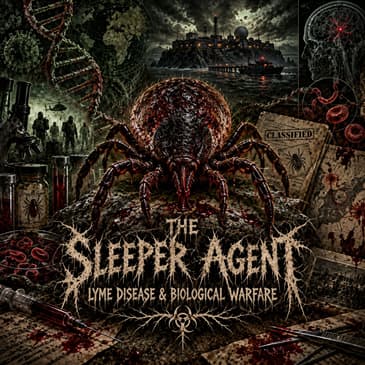
Author and researcher A.W. Finnegan joins the show to discuss his book The Sleeper Agent: The Rise of Lyme Disease, Chronic Illness, and the Great Imitator Antigens of Biological Warfare.
After his own experience with Lyme disease led him down a years-long research path, Finnegan began digging into the history of biological warfare, Nazi virologist Erich Traub, Project Paperclip, Plum Island, and Cold War experiments involving ticks, insects, migratory birds, and infectious disease.
Throughout the conversation, Finnegan lays out his argument that the history of Lyme disease may be far more complicated than the commonly accepted story, pointing to declassified documents, scientific research, government programs, and the concept of immune tolerance as pieces of a much larger puzzle.
We also discuss vaccine research, COVID-era biodefense, government experimentation, why biological weapons can be uniquely difficult to distinguish from naturally occurring outbreaks, and the controversy that follows anyone willing to question established explanations.
Toward the end, Finnegan shares some of the research he has uncovered since publishing The Sleeper Agent and gives a glimpse into his next project, which takes an entirely different direction into the history and folklore surrounding jinn.
Hosted by Simplecast, an AdsWizz company. See pcm.adswizz.com for information about our collection and use of personal data for advertising.
[00:00:03] And I just turned around and I called ass out of there. I was done. I wasn't dealing with that. The hypocrisy of the cult is one of the things that turned me away the quickest. When I turned my headlights on, it turned and looked at us. And one of the things I remember the most were the eyes were glowing red.
[00:00:30] I see an orb of light. It is just circling these steps like it is waiting for me. Just to tell them that he saw a UFO, they're basically like, what are you talking about? That's seven foot up on a tree, peeking around it. And that's where I saw the top of the muzzle, nose, and the eyes.
[00:00:58] As soon as I made eye contact with this thing, it felt like death. Welcome back to Tinfoil Tales. I'm your host, Brandon. Tonight we're joined by my guest, Adam. Adam, thanks for coming on here and talking to me. Yeah, thanks for having me on. Would you like to let the audience know a little bit about yourself?
[00:01:18] Sure. So, I'm the author of The Sleeper Agent, The Rise of Lyme Disease, Chronic Illness, and The Great Imitator Antigens of Biological Warfare. It is a book about, it's the biological weapons race, but it's about the biological weapons that cause slow chronic diseases, neuropsychiatric disorders, neurological disorders, and cancers.
[00:01:44] And it took me about seven years. And it also kind of unravels the Lyme disease origins. And I ended up going to this type, I ended up coming to this type of work because I got sick with Lyme disease. My mother had Lyme disease in like the 2000s. And then I had read a book called Lab 257 about Plum Island.
[00:02:14] So, I was familiar with that by like 2006. And then that book talked about a man named Eric Traub, a German virologist. And so, I got sick in 2016. I had a tick bite. But I don't know if I had it before. But either way, I got a chronic disease. I ended up trying to get it taken care of. And the public health system was just acting really shady about it.
[00:02:42] And then it was very controversial for reasons I didn't understand back then. And then I, when I eventually discovered that it's Lyme disease, I was like, oh, I'm gonna go into this story. This is what I need to do. And so, I kind of, I realized, this is what I'm gonna do. And so, there was a person named John Loftus. He's an author. He wrote America's Nazi Secret.
[00:03:09] And he was the first one to say that Lyme disease came from biological warfare activities. And so, I reached out to him. I had put this timeline together. And he was really impressed by it. And he started to, he introduced me to his biodefense source, who is the source of all of this information. And so, he was able to give me all these hints. He was able to, or not hints, but he was able to steer me in the right direction of what to look into.
[00:03:36] And he was able to say some things that he knew from the classified files. Because him, both John Loftus and this biodefense source had a Q-level clearance. They had a very high level clearances. And so, I started writing the book, met some screenwriters. And they provided me with funding to get a lot of the, all of the stuff I had to buy.
[00:04:02] Like, I had to buy, you know, investigations from German, the German archives. I had to collect all of Eric Chobb's work. So, it was about seven years of just intense research. And it all culminated in that book, The Sleeper Agent. You said your mom had Lyme's disease. Yeah. Did that happen because of a tick? Did they ever figure that out too? As far as I know, it was from the tick.
[00:04:32] But then again, she also had that Lyme Rex vaccine in the late 90s. Mm-hmm . And that was known to cause an indistinguishable disease as Lyme disease. Because it's those little surface proteins that actually are responsible for the chronic effects. Like, you get the spirochete infection, but these little antigens are what kind of trashes your immune system.
[00:05:02] And so, she had that and then ends up having Lyme disease not long after. So, she probably, and she did, she does band birds. She does that bird banding where they put, they track the migration of birds and they put bracelets on the birds. And so, she was exposed to ticks often. I'm pretty sure she did get a tick bite though. But yeah, so she had that.
[00:05:29] And so, I was familiar with a lot of the suffering that she had gone through from that. But when I got it, it was just like, I just kind of felt like they got the wrong person sick. And when I was... I just went... Go ahead. I was going to say... Oh, I was done. Okay. I was done. I was like, when I was eight years old, this was back in 92, I had gotten really sick and they tested me for Lyme disease and Rocky Mount spotted fever.
[00:05:57] Because I had symptoms of all that stuff. And they actually gave me medicine that they treat that with. And I did get better. But as far as I know, everything that they tested me for came back negative. But I had all the symptoms of Lyme disease. That's a common thing. So, you know, I also tested negative on the standard CDC test.
[00:06:20] And then I ended up going to one of those Lyme literate doctors and getting a different test. And they said... They showed that I did have it. And also mycoplasma co-infection and reactivated viruses. That's another thing that is... It's like a complex picture.
[00:06:44] But Eric Traub, the German virologist, he had discovered how all of this works. And he basically... He was at the Rockefeller Institute in the 1930s. And under Richard E. Shope. And he was doing experiments. He wanted to see if he could reactivate a dormant virus from within these mice.
[00:07:10] And so he injected foreign protein into the mouse's brain to kind of give it like the septic shock. And he was able to reactivate... He was able to reactivate a dormant virus called LCM virus or lymphocytic chorio meningitis. And it starts to spread to all the other mice. So he basically figured out how he could start an epidemic from scratch.
[00:07:41] And he noticed that it caused this slow chronic disease. And it basically took out the mouse's immune system. So he was looking at that from the perspective of how can I make this into a weapon? How can I weaponize this for the biological warfare race? And he discovered a condition called immune tolerance. It's basically...
[00:08:09] It's just chronic immunosuppression, chronic immune deficiency. And you think of it like tolerance. And that the immune system is suppressed into a state where it's forced to tolerate harmful pathogens that should otherwise be keeping out of the body. And when that happens, it allows this like central nervous system invasion into your organs. And it just basically slowly turns your body against itself.
[00:08:37] And it's what's responsible in the chronic Lyme disease picture. It's this condition. So he... I realized... I learned about that first before I had even known he discovered it. I had joined a Facebook group for people with Lyme disease. This woman Kathleen Dixon had started called Truth Cares. And she was a former Pfizer biochemist.
[00:09:03] And she taught me all about the immune tolerance and how it works and how... how it reactivates a lot of these dormant viruses from within you. And then allows like, you know, you take your immune... It takes your immune system out and then you also get these opportunistic infections. Like you become susceptible to molds. You get these infections that you otherwise wouldn't get.
[00:09:33] And so it's a very complex picture of disease. It's a very complex disease. So when I started looking into Eric Traub, I discovered that he was the one who discovered this immune tolerance thing. And I just ended up collecting all of his published work. A lot of it was in German. I had to translate it.
[00:10:01] And it was a long... It was just a... I did so much work every day for so many years. And I was finally able to get it into final form. And it's just a really amazing story because I... You know, people look at me like, oh, you must be a conspiracy theorist when I talk about this stuff. And they don't realize how well documented it actually is.
[00:10:27] It's like, I have over a thousand citations in that book of like, you know, leading to official research, declassified government documents, just you name it. And I... Because of the nature of this kind of bioweapons race, it's very stealth and everything is hidden under benign research.
[00:10:54] Everything's hidden under medical therapeutics, cancer research, vaccine research. So it's very well hidden. And it's also... So these types of weapons also are very hidden when they infect people. It's stealth. He wanted to create these diseases that are stealth, took out your immune system, and he wanted to make it as incurable as possible.
[00:11:25] It's just really diabolical what he did. But I have him... So he's at the Rockefeller Institute in the 1930s, and then he's going back to Germany, taking trips back to Germany, visiting labs there, bringing his infected mice over there. And he ends up going...
[00:11:48] He ends up leaving the Rockefeller Institute in 1938 and going back to Germany as the war was about to break out, the Second World War. And he gets a position at the University of Geese under this guy named Carl Beller. It was his mentor over there.
[00:12:08] And 1939 was a huge year because I have him with the spirochetes that were used... That were weaponized into Lyme disease. 1939. So the Lyme disease spirochete... It's like a little worm, for those who don't know. Spirochetes... Yeah, like the syphilis is a spirochete. Borrelia burgdorferi, that's the bacteria of Lyme disease.
[00:12:38] It's like a little teeny little corkscrew worm. And he got it from this bird strain of Lyme disease. It was called Borrelia anserina. And I have him with the spirochete back in 1939. He had his little... He had his protege start growing it. He grabbed it from a Rockefeller psychiatrist named Franz Honnell.
[00:13:05] And it's interesting because psychiatry, that's actually where spirochete research was done under, was psychiatry. So they already understood that these agents could cause problems. Something they don't admit now, you know? Right. They totally... Right?
[00:13:26] And that same year, 1939, his mentor teaches him how if you take a whole bunch of different infections and roll it all into one tick, it creates a very complex disease. And it creates this immune tolerance that he was trying to induce. So most people, when they get Lyme disease, they don't just get Lyme disease.
[00:13:53] They get blood parasites like Babesiosis or Babesia. They get Ehrlichia. They get Rickettsia. They get Bartonella. So it's like... It's kind of like, I call it a Russian doll cocktail that he puts into the... Because you know, it's like a doll within a doll within a doll. Mm-hmm. Those Russian dolls.
[00:14:19] So it's like that, only it's like they're infections overlapping each other. And he... All of these same infections later show up in the black-legged tick during Project Paperclip. And it's very interesting because I went so deep into this. So they didn't... For the black-legged tick, it didn't carry any known human diseases.
[00:14:48] All the way up until 1951, they're still saying it. Right? And then when he comes over and paperclip, it's soon within like five, six years, then they're starting to spread all of these diseases. And he was running a bioweapons lab over in Nazi Germany. It was called Insel Reims. It's at the very northern tip of Germany.
[00:15:18] It's like the German Plum Island. Okay? And it was a... They were doing secret biological warfare research there, but it was all hidden under animal disease. Excuse me. And... The thing about biological warfare... Excuse my throat.
[00:15:41] The thing about biological warfare is the veterinarians made the best bioweapon years. Because a lot of what he was doing was actually... You know, because people think, oh, he's just running a foot-and-mouth disease virus lab. Like foot-and-mouth disease, that virus of cattle that causes blisters on the hoofs and mouth. And so people don't think of it of having any use to human disease.
[00:16:08] But what Eric Traub was doing was turning these animal diseases into human diseases. And because veterinarians know a wide range of different immune systems, it was really like something that was very valuable to the biological weapons game. And this guy was like no other before him and no other after him. As far as I can see, he was like this...
[00:16:36] He was like this evil genius when it came to this type of stuff. And... Back in the 1930s, Germany, they were trying to... They were trying to change that Borrelia anserina, that bird spirochete. They wanted to make a... An animal model of syphilis. And basically, he had to completely remodel the spirochete in so many ways.
[00:17:04] So he was able... They were able to bioengineer things way back then. In like the 1930s and the 40s, they were able to change and modify pathogens considerably. For example, the foot-and-mouth disease virus, like I said, it's a virus of cattle that causes blisters on the mouths and hoofs. But what he was able to do, he was able to...
[00:17:34] He adapts it to mice, gets it to infect mice. And he also changes it so that it becomes a central nervous system disease that acted more like polio. So he would change the properties of it. And the way they did this usually was with different animal passages. Or they would infect certain animals, right? And they would run it...
[00:18:01] Run the agent through this animal, then re-isolate it, and run it through another one. And what he was able to do, he would also alternate different animals. He was getting the virus used to all these different animals. Like, so he wanted to... He wanted to change... He wanted to change the biological agents so that they could infect new species. And that obviously also ties into making animal diseases into human diseases.
[00:18:31] You're just changing the species, right? But they had very sophisticated ways of bioengineering. And he was able to just completely change the spirochete in so many ways. So that Borrelia anserina spirochete, it only infected birds and soft-bodied ticks before that for perhaps millions of years probably.
[00:18:56] When he was able to adapt that to new animals, he got that because the Lyme disease spirochete infects hundreds of different animals. So there was a lot involved in this. They were really... At that German lab, they were really making a lot of progress on the biological weapons front. And so when... Half...
[00:19:25] So at the end of 1945, the Soviet Union captured their lab because they got East Germany. It's on the eastern side of Germany. And they started interrogating everybody there. And they found that there were war crimes being committed. And what they would do was they would blackmail them with war crimes.
[00:19:53] Say, you can work for us or you can go to Nuremberg. And so he... They were able to flip him to like KGB. But also British intelligence was at the center of this too. Because they're basically like... The Soviet Union was more or less like a puppet government in a way of British intelligence.
[00:20:19] And so they get Eric Trav to act against America, to attack America. They're like, we're going to set you up over in the West and your job is going to be to attack America. And what... So he makes this phony escape that was all set up. It was all, you know, it wasn't a real escape. And they get...
[00:20:45] So they get the Americans to take him into the paperclip program. Right? And it was done with these guys. Donald McClain, he's one of the Cambridge Five spies, who later defects to Russia and also Kim Philby.
[00:21:07] They were like, really adamant about getting us to take all of these Nazis over in the paperclip program. And if those... For those who don't know what Project Paperclip is, it was a program where we were taking Nazis to work for us. Because they, you know, under the... They say, oh, well, we need to... We need to beat the Soviets. So we need to take...
[00:21:37] We need to take these Nazis and employ them. So we took Eric Trav over. Right? And he based... They basically put him at the top of the biological warfare program. The United States. And he was advising them on how to run a biological warfare program. He basically gave us all of our biodefense practices.
[00:22:04] And one of these practices are called simulant tests. Simulant as in a simulation of a bioterror attack. And what this would entail is that he would say, okay, we're going to take this harmless bacteria. We're going to spray it all over the city. We're going to see how it spreads out. So that we know how a bioterror attack would unfold.
[00:22:31] And then there was another type of simulant tests where they would infect insects. And they would say, okay, we're going to infect these insects with a harmless simulant bacteria. And we're going to release them. And we're going to track, see how it spreads out. So these were widespread in the 1950s. And like, for example, some might be familiar with the test they did in San Francisco.
[00:22:59] San Francisco, they had a Navy ship that was kind of like off in the coast. And it would spray a cloud of this bacteria over the city of San Francisco. And then, like I said, they would try to see how it spreads out. But what happened was all these people started getting sick and flooding the hospitals. And one person died. And they were, they had never seen infections with this bacteria before.
[00:23:28] It was a bacteria called serratia marcusins. And it leaves like this red pigment everywhere. And that's one of the reasons they like to use it. But it was harmful. And I have him weaponizing that bacteria back in Germany. So it's interesting that when he starts running the simulant program, all these people start getting sick. Right. Right.
[00:23:53] And so what he was also doing was he was running those tick simulant tests, ticks and also mosquitoes. He was running these, those insect tests. And he was, they were doing this at Plum Island. That was one of the things. And he was, um, no, at that time when he was there, Plum Island wasn't set up, um, as like an official laboratory.
[00:24:18] It was kind of like this, it was, it was called, um, it was called Fort Terry and it was owned by the army, but it wasn't set up to the capacity that, you know, the USDA had when they took it over in 1954. Um, they were doing these limited tests there, uh, releasing these ticks.
[00:24:43] And in lab two 57, there's a source who talks about how they had a picture of Eric Traub pointing to the area on the island where he released the ticks. And one thing he was doing, he was going back and forth between Columbia and South America and the East coast of the United States. And what I noticed was he was doing this in parallel with the bird migration pattern.
[00:25:12] Now, one thing people will find interesting is that they are actually trying to find a way to use migratory birds to spread disease. So they had this like bird program and oftentimes the ticks would, would hitch a ride on these birds. And so he's going down to South America, Columbia, and he's coming back up as when the birds would fly south, he'd go to Columbia. And then when the birds were coming back up north had come back up.
[00:25:42] So they had this program and it was in the 1960s. It actually came out. There was something called project star bright. And it was, uh, that was just one of their bird programs, but it just proves that they did have this bird program. And that was one of the things about Lyme disease. It spread, um, widespread through birds and ticks.
[00:26:08] And Eric Chab had noted in 1942 paper, how migratory birds could be used to spread disease to an enemy. So it was like these things were, were being mapped out by Nazi Germany. So when he came over, he was able to tell them all of these different practices.
[00:26:29] Now, most people think most people who are familiar with the simulant tests in the fifties think that it just happened, um, during that time and then stopped after those people died. But that's not what happened. It kept, they kept doing this and it's actually still a, um, common practice for biodefense activities. This is still part of our biodefense.
[00:26:55] Um, and then, you know, when you look at, I don't know if you're familiar with the mosquitoes they're releasing by the, by the millions right now. Yeah. Yeah. Well, that's kind of like a modern day. I guess you could, you could look at it like a modern day stimulant tests, but they're claiming they're trying to breed them out, but they did that to try and come like they're claiming. They're trying to combat the disease carrying mosquitoes. Right.
[00:27:22] But I also saw something that like the Gates foundation, he's been breeding some sort of ticks to release in Africa for cattle to try and wipe out the disease carrying ticks in Africa right now. And I was like, Oh, that doesn't seem a little sus. Right. That. So it's like all of this stuff they, they, and that's what we were seeing in the simulant program is that they would, they would attack us through a channel that was supposed to protect us.
[00:27:52] Right. Like they would always use some kind of cover and say, well, we need to do this because of this and we need to protect against biological warfare. So we need to spread these things all over the place in these simulant tests. And it would always end up where it would be an attack, like a, a bio, it would be like a bio terrorism attack through this. And that's what he was doing.
[00:28:17] And, you know, the Americans were definitely as complicit in doing it. They, they were, if they weren't just, I mean, it's sheer stupidity, but I think there was also an element of intentional harm.
[00:28:35] And we were also, so when Eric Chab was over here in paperclip, he was also designing them biological weapons that we ended up using in the Korean war. In the 1950s, the Korean war, we would, we had these pilots, these, I think they were, I'm not sure if they were CIA, but they were military at least. They would go over there.
[00:29:05] I think it was CIA people. They would fly over Korea and China and they would drop these bug bombs. There'd be these bombs that are loaded up with ticks and insects that when it hits the ground, it spreads everywhere. They, they disperse and then people start getting sick and they shot some of these pilots down and they ended up confessing. Cause it, you know, they're caught red handed.
[00:29:32] They ended up confessing to the Chinese and Koreans. And then the CIA turns around and says, those guys were brainwashed. Those guys were brainwashed. They must've brainwashed these guys with some kind of mind control and then got them to, to make these fake confessions. And that was actually the justification for starting the MK ultra program was because of that incident.
[00:30:03] Um, which people will find interesting. Uh, and that started that whole MK ultra thing. Um, but that's not really, I didn't really cover all of that. I just thought people would find that interesting. And that's kind of like how it started, but yeah. Um, he designed a lot of those bioweapons that they used over there. And at one point, Eric Traub. Okay.
[00:30:30] What happened was the, those, those guys that were involved in getting him over here, uh, Donald McLean, Kim Philovey, they ended up defecting to Moscow. Right. And it caused a huge commotion because Western intelligence is like, wait a minute. These are the guys that sent us all of these Nazis. Now we're finding that they're, uh, working their double agents for the KGB or whatever.
[00:31:00] And then one of John Loftus is, um, somebody that John Loftus knew, his name was Dan Benjamin. Was actually ends up interrogating Eric Traub. He was turning down the Plum Island position too. Like they wanted him to lead Plum Island and be, uh, lead the research there.
[00:31:23] But in order to do that, you had to pass like a extensive background checks and he kept turning it down and they were wondering why he was turning it down. And then when those, you know, those other guys defected to Moscow, um, eventually this guy, Dan Benjamin interrogates Eric Traub. And he studies everything he, he would study everything he knew about Traub.
[00:31:49] And then he would go in and he would walk them through his story. And he, all these contradictions, you know, lies and stuff. And he caught, he caught him basically red handed. It's like all in all these lies. And he says, he says, is there anything you'd like to say before you're being hauled off to, to, uh, hauled off as a spy to be executed? Right. And it was a bluff.
[00:32:16] It didn't really, he didn't really, he didn't really have that going on, but he's told him that. And then Eric Traub broke down and confessed that, yeah, he was, he had been, uh, blackmailed with the war crimes and stuff.
[00:32:30] Um, and instead of being, uh, instead of being tried as a, as a, as a spy and executed, um, they actually just sent him back to West Germany. They sent him back to Germany instead. They, they fired him from all his U S positions and then they sent him back to Germany.
[00:32:57] And now they're starting to see all these diseases start proliferating the United States from all of these simulant activities. And even when we sent him back, so he goes back to West Germany and they set him up at another bioweapons lab in, uh, Tuvenen in Germany.
[00:33:21] And he was still sending, uh, the Americans viruses and the Americans were sending him viruses over there. I mean, it was just crazy. And here's another thing is before he came over here in paperclip, he was made a officer of the UN. He was made an officer of the food and agriculture organization.
[00:33:51] It's like the, it's like the world health organization, but geared towards agriculture. And this gave him, um, and here's another reason why he wasn't prosecuted. This gave him that diplomatic immunity status. A lot of those, um, UN people, they have diplomatic immunity, meaning they can't be prosecuted.
[00:34:16] Um, if they commit any crimes or anything, uh, something that all of them get when they join the UN. And so he was an officer of the FAO, that's the food and agriculture organization. And he was like, he was also, yeah, he had also set up a foot and mouth disease lab in Columbia as well. Um, but he had that diplomatic immunity.
[00:34:46] He gets set up at this other bioweapons lab. Now all these diseases are starting to proliferate the black legged tick by 1955, 1958 starts becoming a serious transmitter of human disease. And by the 1960s, it's really starting to get going.
[00:35:10] So they acknowledged it in 1975, but that's not when it actually, uh, like the outbreak and it had been spreading for 25 years. 1975 was just the year they decided to say, okay, this is a real disease. And, and they, you know, cause there's a cluster of cases in Lyme, old Lyme, Connecticut. And they, and they finally started to take note of it.
[00:35:37] And then by 1982, that's when Willie Bergdorfer, uh, isolated the spirochete for the first time. Uh, as far as we know, I mean, publicly anyway. Um, and in 1953, the year, so right after Eric Chow was sent back, there's a USDA conference about biological warfare. On the, um, poultry, uh, on the poultry and livestock industry.
[00:36:06] And they're talking in this hearing about how diseases are spreading. They, they think that we've been more or less, they're saying, we think we've been hit by bioweapons and this and that. And, uh, they start this whole, like we have these entire units that were created because of this for the USDA.
[00:36:29] And, um, in that hearing, they actually mentioned Borrelia and Serena as one of the agents, as one of the biological agents of special significance. That's kind of like a, a watch word for biological warfare agents.
[00:36:47] Um, and so that was interesting because they never, it was after 1953, it was like, there was a total blackout on that, on that agent because they don't list it. They don't talk about it anywhere. Um, and it's, that was the spirochete that was weaponized into Lyme disease.
[00:37:10] Um, so by 1960, Eric Chow leading that, that West German lab by 1960, he's under investigation for embezzlement. And him and his vice president were just, uh, running amok over there. The vice president was a drunk. He was, uh, sexually harassing all sorts of the female staff.
[00:37:39] And just a big scandal went down. Um, and meanwhile, we're allowing Eric Traub to come back over to the United States to make trips back to the United States to, uh, attend virology. Um, attend virology conferences. Also, they had him attend the opening day ceremony for Plum Island when the USDA finally opened it.
[00:38:07] So, so it's really just, um, a wild story because this guy was just, you know, causing problems wherever he went. And one thing about Lyme disease is it was actually over in Germany first. And then it just follows him wherever he goes. That's what a lot of people. So, yes, it was over in Plum Island. And yes, he was doing those simulant tests there.
[00:38:34] But he had it over in Germany first before. And that's why it was started to spread throughout Europe. And then it follows him wherever he goes. It comes to America. Well, now it's all over America. And also in South America, too. They have a Lyme disease problem down there. Um, so it starts spreading across the globe pretty much. These, these birds, they carry the ticks, um, large for, you know, great distances.
[00:39:05] Um, so those simulant tests, it was like this big thing in the 50s. And that's where I have it as coming from is the simulant tests. Um, another interesting thing I can tell you is there was this Soviet bioweaponeer. He was like this hardline communist, hardline Stalinist communist. His name was MP Chumakov.
[00:39:35] Um, and this guy, he was also testing ticks, testing infected ticks on the Muslims. And Mongolians in Siberia in the late 1930s. So they had their program going. It was well underway.
[00:39:55] And then, um, after all that, uh, MP Chumakov, he teams up with one of our public health people, Albert Sabin, to make the oral polio vaccine. Um, as you know, it's just, it's wild because these are supposed to be two enemy countries. And the FBI clears this guy, Albert Sabin, to go over there and work with MP Chumakov
[00:40:25] to make this oral polio vaccine. And then when he makes it, we find that it's contaminated with that SV40 virus. I don't know if you're familiar with that, but that's, uh, it was this monkey virus that they were finding. And it was, it's a, it's a carcinogen. And they realized the oral polio vaccine.
[00:40:50] It also, it also contaminated the inactive, the inactivated polio vaccine that Jonas soft made. Well, they had that on the market for a full five years, uh, before they even realized it. And even after they realized it, they were never able to get rid of this problem completely because using all these animal tissues and stuff just filled with all of these, um, these different viruses.
[00:41:20] And so that was really interesting that that happened. I mean, it was crazy. And MP Chumakov actually met with Eric Traub in the 1940s, uh, 1947. And he was meeting with him to gain, to gain, uh, what Eric Traub knew about this immune tolerance phenomenon and LCM virus.
[00:41:47] And it's interesting because SB 40 acts a lot like LCM virus. So a lot of coincidences there. And another interesting thing is that MP Chumakov had a son, his name's Konstantin Chumakov. And in the 1980s, Albert Sabin vouches for him to get a job over in the United States.
[00:42:14] He comes over, he gets a job, uh, with, uh, the national Institute of allergy and infectious diseases. Then he works his way up to the FDA and Konstantin Chumakov is the one who approved the COVID vaccine. Um, which is crazy. The irony of us talking about that today was Fauci on the stands. Absolutely. Yeah.
[00:42:42] I, I, I got a bunch of different interviews lined up to talk about that. Yeah. He pled the fifth on just about, he did. He pled the fifth on every single question, even questions like what day is it? I played the fifth. Yeah. Yeah. Right. And so, um, basically what I have here is that I think our public health system has been
[00:43:10] taken over, over the period of like a century, like started British intelligence in the Soviet union. I don't know if you're familiar with a guy named Yuri Bezmanov. You ever heard of him? It sounds familiar. Yeah. He, he, he talked a lot. Like he talked with that guy, G Edward Griffin, who wrote the book about, um, the federal reserve.
[00:43:37] But he talked about how there was a plan in place to take over America and, and, and subvert every aspect of our, of our culture, like make it so that like up is down black is white. Um, all of these mind control programs, basically breaking down civilization, the decline of Western civilization. And that's kind of like what I see in this.
[00:44:07] Cause it's like, it's, they were, they slowly take over the public health system to the point where now they're able to just basically use it as a weapon against us. Um, and they knew that all of these, like these antigens that they use in all these vaccines, they cause this immune tolerance that I talked about. They realized that, but they buried it.
[00:44:36] They, they understood that these antigens cause it. But then in 1960, they give the Nobel prize for immune tolerance to these two guys who didn't even work together and they made it about organ transplant recipients because the same condition can happen in organ transplant recipients. And they basically ignored how it relates to infectious disease. It would have, it would have, if they added, if they had included it into our immunology
[00:45:05] for infectious diseases, we would have started to understand chronic disease since as far back as 1960, like we would have, that would have, they would have figured out how all that works. And, um, instead they buried it yet. They're meeting in these conferences that only the virologists attend. And like, for example, there was a conference called immunological tolerance to microbial antigens.
[00:45:34] So they knew that these antigens could destroy your immune system pretty much. And it's never, they never say anything about it in our public health system. Like they, they didn't include it into the immunology. It just got left out. That's why a lot of people, um, that are chronically ill, they try to go in and get help. And then the doctors were like, oh, we don't see anything wrong with you. There's nothing wrong with you.
[00:46:01] One of the things that happens with this immune tolerance is that because your immune system is so suppressed, you don't have the heavy inflammation that you would see. And like, uh, uh, somebody who had a working immune system, like they get sick and they're visibly sick because that's their immune response kicking in. But this is like, it creates this very low level inflammation.
[00:46:27] Also, they don't make antibodies because the immune system is not functioning properly. So it's a very stealth disease. And they decided to just completely ignore it. And that's, and that's exactly why all these people are sick now. And if they had, if they had acknowledged it, what would also would have happened was that
[00:46:55] we would have realized that the vaccines are causing it too. And so the, the big pharma did not want that. They didn't want, you know, cause they would have had to reconfigure what immunology even is. It's just endlessly jabbing, uh, somebody to create an antibody response. Doesn't actually give them immunity. It's, it's just like, you're slowly burning out the immune system pretty much.
[00:47:22] And you only have one immune system and they, they just think they, they can endlessly jab you. And now, I mean, even today, now they're talking about giving people like multiple vaccines at once, like six vaccines at once and stuff like that craziness. And your immune system is just not built to, to handle stuff like that. Um, they give newborn babies like so many. That's what I mean. That's what I mean.
[00:47:51] And it's just, it's insane. And so the whole autism thing is basically all of these mechanisms that Eric Chab had discovered. What happens is so MMR, for example, that's, that one's notorious for causing these autism, autistic spectrum diseases. Um, and what happens is you give a baby that vaccine and that's a live virus.
[00:48:19] There's three different viruses in it and it's a live virus. And what happens is if you give that to a kid and they, they get immunosuppressed either by the vaccine itself or they have issues going on before it, what happens is just like what happened in Eric Chab's mice. The, the vaccine viruses regain themselves and then they basically set up this chronic infection in that it goes to the brain.
[00:48:47] So the reactivation of, of the vaccine virus, and then it basically causes brain damage. Um, and what is interesting, cause you know, people are still saying, oh, that was, that was debunked. That's, that's, uh, you know, discredited. Um, but when I, there's one thing I'll tell you about sub acute. There's something called sub acute sclerosing panencephalitis.
[00:49:15] It's like a fatal reaction that can happen, um, from the vaccine. Right. And I'm just, I'm just looking it up here cause I have the, uh, thing. There's a, there's a paper where they talk about, um, no, I can't find it.
[00:49:41] There's a paper where they, they admit, okay, the vaccine causes this, uh, sub acute sclerosing panencephalitis. But what that is, that's a fatal, it's a progressive fatal disease. But in the beginning stages, it looks indistinguishable from autism.
[00:50:00] Um, which then basically what it is, is that with autism, instead of progressing into a fatal outcome, it just creates this chronic infection instead. So there's a paper here and I have it pulled up. It's called measles, mumps, rubella vaccine, induced sub acute sclerosing panencephalitis. And encephalitis is like brain swelling, just so you know.
[00:50:29] Um, it said, it talked about how the vaccine caused it. And it said she presented with a two month history of behavioral disturbances, a deterioration in school performance, forgetfulness, silly smiling, handwriting changes, social withdrawal, and ataxia, right? That sounds basically exactly like autism.
[00:50:55] And so when, when all this stuff went down, they basically destroyed that guy, Andrew Wakefield. But this, it's all like right here, like anybody who knows some of this stuff, like some of the mechanisms that Eric Traub had discovered and things like this, you can see exactly how it works and it's just crazy.
[00:51:18] But my point is they keep, they keep all these things in place because from the research out there, it looks like we've been taken over and they're using it as a weapon against us. I mean, it is so sick to know that. And they know that it's, it's harming all these children and they don't care. And then now they're trying to mandate it, right?
[00:51:46] So it's, it's just, it's, it's crazy. And I had been actually injured by a hep B vaccine when I was in eighth grade. And I, cause I was going to Costa Rica for a vacation with my parents. And after I got that vaccine, I started having all of these problems like ADHD, anxiety disorders, depression, all of these mental problems.
[00:52:15] And when I was doing the research from my book, I came across this congressional hearing about the hep B vaccine. And it was like, the name of the hearing was like hep B vaccination, harming or helping public health. And I go and I start looking through it. And it was, the year was 1998. And it was the same year I got mine.
[00:52:38] And all of these parents are testifying at that hearing, how their, their child got that vaccine. Now they have all these mental problems and ADHD and stuff like that. So it's all very relevant. And when you induce this immune tolerance, it brings on what I call the dark triad of immune tolerance.
[00:53:03] The dark triad is like a term for a psychopathic behavior that psychiatry uses, but I just find it works here too. The dark triad of immune tolerance is that it brings on chronic disease, neuropsychiatric and neurological disorders and cancers. So that's kind of a big deal is that's, that's exactly what these, these vaccines are doing.
[00:53:30] And what I found was that this COVID vaccine actually causes it. There's a paper. It says IgG for antibodies induced by repeated vaccination may generate immune tolerance to the SARS coronavirus to spike protein. And he talked about this paper. It said, um, the repeated mRNA vaccination with high antigen concentrations may also cause
[00:53:57] autoimmune diseases and promote cancer growth and autoimmune myocarditis and susceptible individuals. And it's just crazy because it's still on the market. And not only is it still on the market, they're trying to give it to our children. And it's, uh, it's just, it's so over the top. So I had a couple of questions about some stuff and kind of want to touch base on this.
[00:54:27] So when you started researching, you, you were basically, you'd gotten Lyme disease. So this kind of led you down the path to start researching and everything. Where did you first come about where you realized that there was more to it than just a normal disease. Was that once you started to like really dive into the Eric trope? Yeah, it was like, I think it really clicked.
[00:54:51] Actually, it really clicked when Kathleen Dixon, the woman from who started that Lyme disease group, because she was explaining how the disease works. And it just totally kind of flipped my idea of how immunology and everything works. And, um, it took me like a year of just constantly being, you know, explained it where I think it just eventually just clicked.
[00:55:20] And then I started, when I started looking into Eric trope and discovered that he was the discoverer of immune tolerance. I was like, Whoa, this is, this is something else. And so, yeah. And, you know, before that, I didn't like science. I didn't, I didn't even want to learn all this stuff. And this girl that I was seeing at the time, she's like, no, you've got to learn this.
[00:55:49] It'll do so much for you. If you just learn the science and start going through science papers and stuff. And that's kind of like what I did. And, you know, at first it was like all of these medical, all of these medical terms. I had no idea what any of it meant. Cause most people look at a, a, a science paper and it does, it's like illegible to them. They don't, they don't really know what the heck it's even saying.
[00:56:14] Um, and it took me like a few years of really just going at it every day to start getting a, a, a, a grasp on everything. And I think that to answer your question, like it was, it was when I met Kathleen and then started looking into Eric trope, I just, it really started to make sense.
[00:56:38] And one thing I'll say about Eric trope's work is he, he was very like, like you really had to study his work hard to understand what was going on. Cause it doesn't make, it wouldn't make sense to a lot of people. And he's very, um, he says things, he makes vague statements, uh, that you have to like decipher what he's basically saying. And it was a lot of work. Yeah.
[00:57:08] I mean, I never, it was weird because it was like, I just felt like I was driven by a force beyond myself. That's the only way I can describe it. Um, and so I went into this and then also knowing John Loftus, cause if I didn't know him, then I wouldn't have understood all of these intelligence angles and all of the stuff that his, his biodefense source was telling me.
[00:57:36] So knowing those two people or yeah, knowing Kathleen and then knowing, um, that biodefense source were like two keys to the, to the puzzle, uh, that it was like they unlocked all the other doors. Um, so it was just a very, it was like, it just all kind of fell into place. I don't know how to say it. It, it all just kind of fell into place. And I was just driven every day.
[00:58:05] I was just chipping away every day, sometimes 12 hours a day. I remember cause the girl that I was seeing, she got so sick of hearing about it. Cause that's all I would talk about for like so long. And, uh, it becomes like an obsession. Yeah. And so I just, I got the thing done and I ended up publishing it with trying to, I ended up
[00:58:32] getting a job with trying to, um, doing like the marketing and everything. I've been working there for a few years and, uh, that's kind of how it all fell into place. I would say. Has there been anyone that's kind of pushed back against the book? There's actually one person that I can think of that has been really trying, really trying
[00:58:58] to discredit the book and he basically just uses AI and tries to, uh, he's got this, this social media account named Hengen. Uh, he's, he's on X. Uh, I think it's, it's like out of, it's an account out of Finland and it's an anonymous account. So it could very well be the establishment. Um, but he puts it like this whole website together.
[00:59:26] He doesn't just attack me though. He attacks like all sorts of other people that I know too. Um, that's really the only pushback that I've, so as far as the establishment is concerned, they just completely ignore it. Like there's no Wikipedia page about the book. There's nothing. Uh, they don't draw any attention to it.
[00:59:51] And cause if they did, people would read it and all the people that have read it are just blown. They would like a lot of people that I knew that had Lyme disease for a long time. A lot of them are really blown away at just how, um, cause that's a deep book. It's, it's a really deep book. As you can tell from this conversation is, is it kind of a deep conversation we're having?
[01:00:15] And I also had to, one of the things I had to do is learn how to explain it to people in a way that they could understand it. Cause a lot of it's very technical, uh, a lot of medical terms, you know, scientific big words and stuff. And when I first had the thing written, it was over a thousand pages.
[01:00:40] And I quickly learned like, okay, well, you know, people don't really have time to read a thousand page. So I had to condense that. I condensed it into like 316 pages. Um, and I really tried to like spell it out as best I could like try to make it so that a kid could kind of understand it. I mean, it's still kind of technical, but I did, I think I did the best job that I could
[01:01:09] have done as far as explaining it to people that didn't understand that have no understanding of all this stuff. My history with Lyme's disease, basically it, they determined and call it Lyme disease because it was found right off in that old line. Yeah. Yeah. And it was near Plum Island, which Plum Island has all sorts of conspiracies theories about
[01:01:36] it in any ways, because obviously they do infectious disease stuff there. So there's been all sorts of weird stories that come out around Plum Island anyways. Mm-hmm. But to me, like throughout history, they claim there's been Lyme's disease cases, but it was never called Lyme's disease because they've had the same symptoms, but it was never really determined where it came from or anything like that.
[01:02:02] So for stuff like that and like for the person out there that ends up getting it or something, they didn't manufacture it from that point, but I think they released the strain of, you know what I mean? Like, I think there were symptoms from that stuff before, but I think it's like what you're trying to get to is they're kind of releasing things. Am I right? Yeah. Yeah. And to, to, to address something else.
[01:02:31] So I don't, so the thing about Lyme disease is that there's a lot of these Lyme-like diseases as well, but they're all basic, they can, they can be caused by different things. Like, so anything that has that antigen on it can cause a very similar disease that would be almost indistinguishable. So, um, but as far as the Borrelia burgdorferi spirochete, so they put all these papers out,
[01:03:01] right? Like they say, oh, we found it in an Iceman from thousands of years ago. And they're, they're telling everybody this as fact. But then when I go and I, I look at the actual studies, they say in the studies, we don't even know what bacteria is. We just think it could be Lyme disease. Like they didn't even know if it was the spirochete. They didn't know if it was even the genus Borrelia.
[01:03:28] They said there's this, they basically said there's a 50% chance that this could be Lyme disease, but they have no idea. And they didn't have any, like there was no organism they had. They're just trying to, they're just testing on the tissues and stuff. And so that was a really, cause they, they have absolutely no idea that it's in there. They're just, they're pushing it as though it is.
[01:03:56] And then what I find is there's all these other papers talking about, it's been here for thousands of years, but it's all based on theories. Like they, they're looking at mutation rates of field samples and they're guessing that it's been here for, you know, however long because of certain mutation rates. It's hard to explain. It's called phylogeography.
[01:04:18] But, um, and that I just found, you know, there's no way they didn't have any evidence of it back then. Um, it's all just kind of, they're pushing this and it's, and it's shady because why are they, why are they using bad science? Another example is they, um, we're testing the ticks and like mouse samples from like the
[01:04:46] 1800s and they didn't even, so they test for this small outer surface protein, which is, it's called extracellular DNA. And it changes regularly and rapidly due to the environment it comes into contact with, but they didn't test for the flagellin gene, which is from the actual spirochete.
[01:05:09] Just to put this in, you know, simple terms is they, they used really bad tests and, and they didn't even, they didn't even have any confirmation that any of this was infected with Borrelia burgdorferi, but they just, they jumped the gun and they start pushing it as fact. That's where, so the Borrelia anserina spirochete that I, that I put forward as being weaponized
[01:05:37] into Lyme disease that existed for thousands of millions of years. Like that, that strain has been around for millions of years, perhaps. Um, but what he did was, and it infected birds only what he did was he, he gave it some extra proteins that it used. He gave it a lot of different properties.
[01:06:01] He was able to completely remodel it and then he was able to adapt it to hundreds of new animals that it didn't infect before. And also to humans. So that's kind of like what it is and yeah, they're releasing it, but he definitely took that spirochete and he remodeled it completely with all of these bioengineering, um, capabilities that he had. And I, I just put out a new article actually at my sub stack covering all of this.
[01:06:31] Uh, it's a really in-depth article, um, about it being a man-made event because they, here's another interesting thing is that Borrelia burgdorferi is the most abundant spirochete or the most abundant form of Borrelia on the planet. It's like a hunt, it's like 10 to a hundred times more abundant than the typical relapsing
[01:06:57] fever Borrelia, which is, that's like the, there's like three groups of Borrelia. There's a relapsing fever Borrelia. There's a Lyme Borrelia. And then there's like this group that's kind of sits in the middle. They had, they had discovered all of these other ones, like from a very early time, but even though they say Borrelia burgdorferi is, is 10 to a hundred times more abundant than any
[01:07:26] of the other ones, they didn't find a single sample of it all the way up to 1982. Right. And they also said that, um, there are like, there are contradictions in the, in the, um, is it the, oh, like the way that it spreads out in the tick.
[01:07:52] Like they, they just find that the spirochete had come from like Africa and Borrelia and Serena while the black legged tick is like coming from like, um, Canada or Alaska, like over in Russia. And then it kind of over, you know, thousands of years started making its way into America. And they just found that it, it didn't seem to make sense.
[01:08:21] And the, the, the army and the military started using that tick and simulant tests because they said it doesn't carry any known human diseases. So they were like, okay, we're going to use harmless tick. And then all of a sudden within a few years, it's got all of these diseases, the very same diseases that Eric Traub was learning about in 1939.
[01:08:49] So I've got like a, uh, I've got it kind of like all mapped out, um, to, to the best ability that I could do it. And, um, I basically took so many years looking at all this stuff. Cause I really wanted to, I wanted it to be accurate. I don't want to say anything that's not true or anything like that. And the picture has to make sense in a way that nothing contradicts it.
[01:09:17] That's like a big part of putting this story together. Cause you're drawing from so many different sources. You're, you're trying to put a picture together based on limited data. And, but in order to do that, you have to make sure everything makes sense and it's not contradicted by this or that, or this or that. So I, I have been spending just years on that and I, I've got it to a point where back.
[01:09:45] And like I said before, back in 1930s, Germany, they were actively trying to turn that Borrelia and Serena, uh, spirochete into an animal model of syphilis. And that's where I have him like start changing it. Cause in order to do that, he would have had to remodel that spirochete considerably. And that's kind of like what I talked about in my last sub stack article.
[01:10:11] I really laid that out how, cause I, I went into like all of the genetics of it and everything. Do you think that some of the stuff that's in your book, like when people read this or whatever, is there anything in there that someone's going to have, like misunderstand obviously like what you're trying to do? Like I, I, I feel like when people like they listen to you on, like if they were pick up
[01:10:39] your book and they read it, is there anything in there that you think that it's hard for them to understand like where you're going at with it? Cause I understand in the sense that you're trying to bring light to the fact that these types of things are being released on the public and to the average person that doesn't necessarily believe in this type of conspiracy or whatever, that it is feasible of why the government would do something like this or why people would do stuff like this.
[01:11:10] I believe it because I don't trust them. Yeah, no, I, but like to the, to the average person. Which person, how would you explain to them? Like how you come to this conclusion? It's basically war. Like weapons of war are very irrational, right? Like making nuclear weapons is very irrational. Cause a lot of people say, why would they make a biological weapon when it could come back on that?
[01:11:36] Um, well it's, it's during, you know, you're creating weapons of war. Well, there's been plenty of instances where they've created weapons that have come back on them. And, you know, just like in the, in the, when they were creating nuclear weapons, there were guys that were working on those weapons that ended up dying because. You know, they were, they were messing around with the plutonium and everything.
[01:12:06] And they didn't even bother to put on the special suits that they should wear. So that in case something went wrong, they wouldn't get killed by it. And they didn't wear any of those suits and, and accidents happen. Two guys actually had a big flash of radiation and they were dead within like a day or so. Uh, it's, it's war is a very irrational thing, but all of these countries, they engage in it, even though it could come back on them.
[01:12:36] Um, but to answer your question, I would say, I don't, I don't think that people would really get the wrong idea if they were, if they were looking at it, because I, I basically, after every sentence, I have a citation that goes to something that I'm talking about that's relevant to what I'm talking about. Right. So it's, it's very well documented the way I did this.
[01:13:01] Um, I basically cited that book, like it was a medical paper pretty much from all the years of, of learning how those, you know, from reading them all. Um, it was always very important to me to back up everything I'm saying so that, so that these misunderstandings couldn't really happen. Um, one thing I will say is I had John Loftus write the introduction to it. Right.
[01:13:30] And in the beginning, and I, and I think that was good that I did that because he was saying it from a position of having a, the highest level security clearance. And he was also in military intelligence at one point. And then he talks about his bio defense source, telling him all of this stuff that happened, which I then talk about in the book.
[01:13:55] So it starts off with John Loftus basically talking about the story of how he came to know about all this stuff through this bio defense source. And then I kind of start, then I take over in the, in the beginning chapter is a, there's a preliminary chapter. I called the, the five, I think it's like the five points of biological warfare.
[01:14:21] And I explained like these key points to understanding the story that there's different types of biological agents. There's those that kill fast and there's those that kill slowly and leave you with these chronic diseases. I told, I told them about how before the days of the modern genetic engineering technology,
[01:14:44] I, I told them how they, um, how they modified pathogens with these animal passages and such. I also told them in the beginning how a lot of this, uh, how biological warfare is waged through intelligence channels, like having people sabotage, um, people having spies come over like Eric
[01:15:11] Traub and sabotage the country from within. So I laid out a lot of these concepts for people to kind of understand before they embarked on the, on the journey of reading through the book. And I think that definitely had a good effect. I have not come across anyone who, who got the wrong idea.
[01:15:36] I think everybody was, I, so far the feedback that I have gotten from people is they, they think it was just, it's very well documented. They can see all of the sources that I'm using. Um, it was, it was very, it was very clear cut, like hard to misunderstand, except the only thing I would say is some people couldn't really grasp the science behind it.
[01:16:05] And I tried to make that as digestible as possible. Um, but there's only so much I could do, but I think overall, I mean, some people would read it and they're just blown away and they, they understood it. And they, it's, it's really great when I hear from people like that, that just totally got it. Like just understood. Cause they being sick themselves. A lot of them, cause I got a lot of people that read the book that have Lyme disease and
[01:16:34] such, and they're already familiar with a lot of this stuff. So I think it's been very well received so far. How long has it been out for now? It was published in December of 2023. Okay. That's been out for a couple of years. Yeah. And it's ironic to me that out of all the years that it's been out now that you've only
[01:17:02] had that one person that's kind of, but he's not just targeting you, he targets other people. So it almost seems like it is some sort of a plant that is specifically trying to discredit things. Yeah. And I think, you know, how, how convenient they just use this anonymous account and I don't know who the attacker actually is, you know? But it definitely, I mean, he puts these hundreds of pages and all he does is he asks
[01:17:32] rock, ask rock and has rock come up with these fancy explanations. And then I have to counter that and everything. But I think, I think the other, uh, approaches for them to completely ignore it, try to not mention it, try to just completely act like it doesn't exist. And that's, I think was how most, how it's been dealt with, uh, by the establishment. Cause there's definitely people that understand.
[01:18:01] I mean, when I have my, my website, the sleeperagent.com and I get visitors from, um, places, you know, like government institutions and such and military places. Um, so they're definitely aware of that. And especially since John Loftus, his name is on it, you know, he, he had a very high
[01:18:27] level clearance and he wrote the book, not America's Nazi secret. And in that book is where he talked about them releasing what he called poison ticks. Not really poison. Cause it's a poison is like for a plant material, but he was talking about how they were releasing these ticks at Plum Island in that book. And that was published in 1982 under the name, the Belarus secret.
[01:18:56] Um, so I think it was very good that I had him write that. I think that did a lot for the book too, for the people that maybe they don't want to take my word for it, but to hear him say it first in the very beginning, I think that did a lot for the book. Definitely. What is the one thing in the book that you, I don't want to call it like the smoking gun, but like the biggest piece that you have in your book that kind of shows like there is something to this.
[01:19:28] Oh, um, well, there's so many elements that I cover. So it's kind of hard to answer as far as like the Lyme disease thing. I've got it. What this is, it's not like one piece of evidence is that I use tons of circumciliac, circumstantial evidence to the point where it's like overwhelming. Um, just cause that's, that's actually a more reliable.
[01:19:53] It's called what is what is called is mosaic intelligence where you draw from a large net of different sources and you tie the picture all together in a very cohesive way where all of this, um, all of this evidence from diverse sources is all converging into this picture that you're presenting. And that's, you know, like that's, that's how it's done in a court of law. Right. Right.
[01:20:23] So that's the way I approach this book. I wanted to say, okay, I'm going to act like I'm in a court of law. So draw from official documents, declassified files, published research, um, also statistics stuff. Um, and then firsthand first person testimony, people like loftists, all that stuff comes into play and how it would be presented in a court of law.
[01:20:51] And that was really the, uh, the thing I took, but I wanted to show people that this, there is this biological warfare race that's been going on and actually bio bio warfare itself has been, uh, they've been using it for a very long time. And that was one of the things that John loftus said in the introduction. He said, he said a third of modern history has been classified.
[01:21:18] And that's why the public doesn't hear about any of this stuff. That's why the public thinks it's a conspiracy theory because they don't, they don't say, they don't talk about any of this stuff. It's all highly classified, all the stuff that goes on. That's why, that's why it's interesting because the, the government, what happens when anybody's talks about a lab origin, they're labeled as a conspiracy theorist, but yet, but yet they're,
[01:21:47] they're having us pay millions of billions of dollars every year to protect against bioterrorism. Right. Right. But we don't call them crazy for suggesting that it was, that it would actually take place. Like they're, they're calling us crazy for suggesting it, but then they're saying we need your tax money to protect against it.
[01:22:10] You know, so it's very, uh, and it goes, it goes back to the whole, that, that term conspiracy theorists. It's something that the CIA kind of created during the, uh, JFK assassination. When people started to ask the wrong questions, they say, okay, we need a weaponized term for this and get, make them look crazy. And that's where, you know, that took on a whole new life.
[01:22:37] And it's interesting is like, even when people say conspiracy theorists about my work, it's like, well, I never really even said it was a, a big unified conspiracy. I said, it's war, it's war. And there are definitely conspiracies involved, I'd say, but just even, even if you didn't want to take that element, I say it's war. I like it. Countries go to war against each other countries, uh, you know, so it's just, so when somebody says that it doesn't make a lot of sense.
[01:23:07] And it's, it just kind of exposes the fact that they can't actually argue with the, with, with my story. They just want to use the, uh, ad hominem attacks. I look at it as like biological warfare in the sense that you mentioned nuclear weapons and dropping bombs and everything else. Somehow they have to test that stuff.
[01:23:27] Well, this is like them testing the same type of thing, but they're not testing it on a Nevada testing field or releasing it on society. And that is how they get their results or what they're looking for because they need human trials. No one's going to volunteer to come up there and make me sick. They're going to have to try something else. That's true. Yeah, that is true. And here's another interesting thing.
[01:23:56] Biological warfare is the only thing. It's the only kind of weapon that you can get away with saying, oh, it wasn't me. It was an act of nature. You can't do that with chemical weapons, right? You can't do that with nuclear weapons, but biological warfare is the only thing that they could attack their enemy, but then say, we didn't do that. It was an act of nature. It was a natural outbreak. Right. Right.
[01:24:23] And what's interesting with like, for example, with the whole COVID-19 thing where they're saying, oh, it came from animals. Right. Came from animals. But if they have. In gain of function research, they often use animals. Right. In all of the labs, like they're passing things between ferrets and such. You know, that's just one example of gain of function research. So they say, oh, well, it's closest to a virus of this animal.
[01:24:51] But if they have those animals in a lab, it makes the whole idea irrelevant. Like it's like, well, if you could have these animals in a lab and you're creating it that way, then, you know, and that's one of the things they do to blame it on nature. Because like a lot of the development takes place in animals in the lab. You know. I wonder if like when this stuff goes on, if people.
[01:25:22] I guess I have to you have to look at it from their perspective, but like who in the right mind would be OK with doing stuff like this? It takes like a it takes like a sick type of a person to be like, hey, you know what? I'm going to release this to see if all my work. I don't. It just seems like there's got to be a switch because I don't think I could be the type of person that would just want to go out. Absolutely. Totally. I'm glad you brought that up.
[01:25:49] And Eric Chobb, for example, in the FBI investigations, they were interviewing people who knew him. And they kept saying that they were disturbed by his cruelty towards animals. They were disturbed by him always going out of his way to be cruel, cruel to the animals that he was working with in the lab, which tells you the kind of person you're dealing with.
[01:26:14] You know, like people that want to hurt animals, defenseless animals like that, like he would do. And they said he was like a very angry person. He's very he had a temper and he went out of his way to be cruel to animals, which that kind of brings in like a psychopathic component. You know, I feel like for them it would like.
[01:26:39] Like, it is like that psychopathic thing, like they are basically mass murderers. Yeah. And just a different type of setting. Like they're not going around like as a serial killer, but that's basically what they're doing because they're releasing a disease that goes around and eventually kills people.
[01:26:55] Absolutely. And then when we look at the same idea relating to how all of these public health officials can be totally OK with destroying children's health with a lot of these vaccines, they know that it's causing all this stuff. Like they understand all this, like all that Eric, all of that Eric Traub's work and stuff and how it relates to this there.
[01:27:18] They understand all that and they know how all this works and how they could be just totally OK with allowing just like the mass brutality of our children, just destroying their brains, robbing them of their potential before they even have a chance to start living, you know?
[01:27:43] Because there's some over the years being involved in the in like fighting vaccine mandates and stuff. I've seen some of the parents with like vaccine, like really vaccine damaged kids like the, you know, like some of them have to wear like helmets. They don't bang their heads on the wall and some of them would be like, you know, they're just so messed up and so destroyed that they have to be taken care of.
[01:28:12] And like they will like, you know, like smear feces on the wall and stuff, just stuff that like just the average person could not comprehend living like that.
[01:28:25] And I see these people all the time and these politicians at these hearings, they get up there and they call everybody conspiracy theorists, anti-vaccine conspiracy theorists to all of their faces while they're holding their vaccine damaged child, you know? So it's like the nerve of some of these people, it's sickness.
[01:28:50] I mean, I don't know about you, but I believe in I'm a spiritual person and stuff. And I do believe there is kind of the antithesis of love where it's just cruelty, hatred, darkness, the absence of God, you could call it. But, uh, and I think like, for example, Trav was just kind of one of those people too.
[01:29:16] He definitely, it definitely had certain people, um, you had to be cut from a certain cloth, you could say. Right. I think, again, some people are just, for a proper better term, I'm just going to call them whack jobs, but some people are just straight up evil. Yes. Right. I agree with you there.
[01:29:46] Definitely. Um, and you know, like having, cause I've been reading in the whole conspiracy realm for like years. I've read so many books and it's just, cause I'm always just trying to understand the world around me. I'm trying to understand all this stuff.
[01:30:04] Cause I, you know, like I have to, it has to make sense to me and I have to, I, I just, I read far and wide and, and I just, some of the stuff that I've read over the years, it just boggles the mind. It's like, wow, like how somebody could be so just evil. Yeah.
[01:30:26] I figure we will try and wrap this up here in a few minutes, but there's a couple other things I was wanting to talk to you about now that this is out since you said it came out in 2023. Has there been anything since then that you've uncovered that's not included in the book? Yeah.
[01:30:46] I would say, um, I would say, especially as it relates to some of the, the COVID vaccine and, and some of how, you know, like, cause for example, they, they're finding that it causes this immune tolerance. Well, I find after the book that they were trying to use immune tolerance as a defense strategy.
[01:31:12] Like, so the Bill and Melinda Gates foundation and NIH were working together in 2012 and they published a paper called disease tolerance as a defense strategy. And disease tolerance is just a word for immune tolerance. And they're looking at it as an acceptable form of immunity.
[01:31:32] Basically in, in layman's terms, we take out the immune system so that it can't have a fatal response to whatever pathogen that we need to protect against. But so we're going to destroy the immune system. But then when you look at the history of immune tolerance, that would be absolutely absurd to do because then you get that dark triad, chronic disease, neurological disorders and cancers.
[01:31:58] You get an avalanche of those three things and it wouldn't, it would not make any logical sense to use that as a form of immunity. Right. Right. So that's one thing that I came across afterwards that I realized that they're actually trying to use it as a defense strategy. They, they say, we need to make vaccines that'll induce this immune tolerance.
[01:32:21] And, um, you know, like Bill Gates, for example, a lot of people are aware of that Ted talk he gave, right? I'm sure you, you might've seen it where he's talking about how we could get the, the, the population numbers down if we do a good job on vaccines. Right. Yeah. He actually said that. How do you misinterpret that? You know what I mean?
[01:32:47] Like how, how else are you supposed to, cause they try to come up with these fancy explanations as to why he said that. And it didn't actually mean what he was saying, but it totally does. And then when you, you see him funding papers like this. Oh, and another thing I, I came across after the book was, uh, this Epstein guy.
[01:33:08] Um, I found that he was all wrapped up in our bio defense, um, working with people, which is, it's, you know, I mean, take one look at that guy and what he was involved with. And to, to know that he was, I actually put a, I put a sub stack article out about, um, about Jeffrey Epstein's involvement in our bio defense.
[01:33:33] Uh, and so I covered that, but yeah, there's, there's different things, especially, uh, in the realm of, of vaccines that, and, and things like this that came out after. But I think I definitely covered the story that I was trying to focus specifically on and, and that, especially Eric Chobb's life.
[01:34:00] Um, but there's definitely, there's more stuff coming out and I'm kind of, uh, collecting it all. I'm going to write a follow-up. Definitely. I was going to say, I was going to ask you if you're doing anything now, since this has been out, if you've been working on anything new. Yeah, I actually, I'm going to write a different book about the, how it relates, how immune tolerance and vaccines play into each other. But I haven't really got that underway.
[01:34:28] I am writing a different book that's on a completely different subject altogether. I'm writing a book about the djinn of Arabic, uh, the genies, uh, the race. Um, I'm writing a really good book on that. Cause that's, that's an, that's an area that I also have an interest in just like researching. And I've been collecting material for years about, about that subject.
[01:34:57] And it's, uh, it's going to be like no other book on the subject. Awesome. I think, uh, whenever you get that done, I'd love to have you back on. We can talk more about it. Cause that's something. Cause that would be a really interesting conversation, especially for the type of stuff that you cover. That would be right up your alley. Definitely. And it's going to be, when I do write that book, I'll definitely come on and we'll talk about that. And it'll be a really interesting conversation. I can promise you. Yeah. I'd love to hear about it.
[01:35:27] That's the one thing that I haven't had on my show yet. Is anyone really talking about gender genies or anything like that? So straight up something. I'd love to talk. I've got years of research on it too. And I'm, I'm, I draw from a lot of academic sources and believe it or not, a lot of this is talked about in academic sources. They just cover it as folklore, but they talk about it. Like it's real in a lot of the papers.
[01:35:51] Like, for example, there's a, there, one of the aspects that I'm covering in this book is the human and jinn intermarriages. So when under Islam, there was in the 14th century, the scholar who was tasked with coming up with the legal framework, because it was so common back then that people were having these, you know, intermarriages with humans and jinn.
[01:36:17] And they were trying to figure out the legal framework, how they should approach it. It's just a really interesting thing.
[01:36:24] Um, and I, I also would say that, um, what I do is I think that all of the different terms like fairy, um, nagas, the nagas of Asia genies, they're all basically the same race, but they take different forms depending on the different cultures, because it's just like humans between, you know, when you go to different cultures, people are different. Right.
[01:36:53] Um, so I tied it all together, how it's like related to the elementals, how it's all this, this one race. And I talked about, you know, about the Ubaid figurines that they find in the Sumerian where they have these reptilian looking heads, all these figurines that they find with the, they look like reptiles and stuff. Well, I, I kind of tie all that into it. It just, it's going to be a really good book. It's going to be a really good book. Yeah.
[01:37:22] I'll definitely be on the lookout for whenever that comes out and make sure to get in touch with me. Cause I'd love to have you back on about it. Definitely. Would you like to let everyone know where they can find your book at right now? Yep. You can find it at, well, you can get it on Amazon, but also it, they basically like take half the money, but you can also find it, which is fine. And I know, cause I use Amazon too. It's, it's convenient.
[01:37:52] Um, you can also find it at trinday.com. Um, and then you can go to the sleeper agent.com to find my website about the book. And as far as my social media, all of my social media are under the handle at a W Finnegan F I N N E G A N. So like sub stack, that's my handle there.
[01:38:21] YouTube also on X. If you can send me an email of that link, I will put it in the show notes for everyone that listens. Sure. We've been going on for almost an hour and 40 minutes. So we're probably going to wrap this one up, but I just want to say thanks for coming on here and talking with me tonight. Yeah. It was my pleasure. It's been a pleasure for me again. Everyone listening, make sure to check out the show notes.
[01:38:48] You can check out the book and everything else, but I just want to say thank you. Yeah. Thank you for having me on. Yep. You have a good night. You too. If you would like to be a guest on tinfoil tells, remember to send an email to tinfoiltelspodcast at gmail.com, or you can also go to tinfoiltels.com and go to the contact section. Just make sure to reach out and get a hold of me and we will get something scheduled for a future episode.
[01:39:18] You can also find tinfoil tells on Facebook and Instagram. Just look for tinfoil tells podcast. You reach out to me that way too. Remember to share the show around. Word of mouth is the best way to help the show grow. And just remember, truth comes at cost. Are you willing to pay the price?