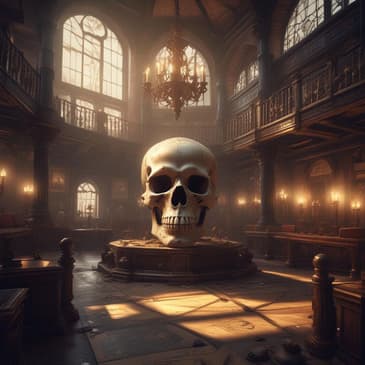
Welcome back to Tinfoil Tales! On this episode I talk to Mark, the host of My Family Thinks I'm Crazy Podcast about the mysterious Skull and Bones secret society that originated back over 200 years ago at Yale University.
You can find Mark's show anywhere you listen to Tinfoil Tales or by checking out his website http://www.myfamilythinksimcrazy.com
Tinfoil Tales Podcast - Show Notes
Share Your Story!
- Got a paranormal encounter, conspiracy theory, or unexplained story? We want to hear it! Reach out at tinfoiltalespodcast@gmail.com or our website.
- Follow us on Facebook, and Instagram!
- Subscribe to our YouTube channel to watch the monthly livestream Tinfoil Tales: After Dark on the last Thursday of every month
- Join our Patreon community for exclusive benefits like early access and ad-free episodes.
- Join now for free or for only $1.99 a month for unlimited access.
- Visit the merch store for Tinfoil Tales stickers, shirts, hats, etc.
- Bigfoot, Brews & Spirits Too! (Sept 14, 2024): Mingle with fellow mystery lovers at Sister Lakes Brewing Company in Dowagiac, MI.
- Indiana Bigfoot Conference (Sept 27-28, 2024): Hear from experts and network at Seasons Lodge in Nashville, IN.
- ParaUnity 6 (Oct 19, 2024): Explore all things paranormal at Miami County 4H Fairgrounds in Peru, IN.
- Crawfordsville Paranormal Convention (Oct 26, 2024): Meet investigators and explore vendors in Crawfordsville, IN.
- All music for the podcast was written and performed by Devin Gowin.
- For those interested in hiring Devin, you can reach him at harmonicgray@gmail.com.
- The views expressed are those of the guests and do not reflect the podcast or host. We encourage you to think critically and form your own opinions.
Thank you for listening!
Become a supporter of this podcast: https://www.spreaker.com/podcast/tinfoil-tales--6147818/support.
Want to be a Guest?
If you have a paranormal encounter, conspiracy theory, or unexplained story to share, we'd love to hear from you! Reach out to us at tinfoiltalespodcast@gmail.com or use the contact button on our website.
http://www.tinfoiltales.com
Let's schedule you for a future episode and dive into the mysteries together!
Got Weird Stuff?
Have some strange physical evidence you want to share?
Mail it to:
Tinfoil Tales
P.O. Box 302
Peru, IN 46970
📱 Follow Us on Social Media:
Stay engaged on Facebook to join the conversation.
http://www.facebook.com/tinfoiltales and look for Brandon Tinfoil Tales
Explore mysterious visuals on Instagram and share your own experiences.
https://www.instagram.com/tinfoiltalespodcast
📺 Subscribe to our YouTube Channel:
Hosted by Simplecast, an AdsWizz company. See pcm.adswizz.com for information about our collection and use of personal data for advertising.
And I just turned around and I call ass out of there. I was done. I wasn't deal with that. The hypocrisy of the cult is one of the things that turned me away the quickest. When I turned my head lights on, it turned and looked at us. And one of the things I remember the most, where the eyes were going red. I see an orb of light. It is just circling these steps like it is waiting for me. And he begins to tell them that he saw UFO. They're basically like, what are you talking about. That's seven foot up on a tree, peeking around it, and that's where I saw the top of the muzzle, nose and the eyes. As soon as I made eye contact with this thing, I don't like death. Welcome back to Tenfoil Tells. I'm your host, Brandon rag Night. We're gonna be joined by my guest Mark. Mark is the host of My Family Thinks Some Crazy podcast. I reached out to Mark a while back to come on here and talk a little bit about some stuff tonight. The name of his podcast kind of resonates with me because I think everyone thinks I'm crazy too, But each thrown I guess. Before we bring Mark on though, if you've ever had an experience and you'd like to be on an episode of tenfoil Tells, please send an email to tenfoil Tells podcast at gmail dot com or go to tenfoiltl dot com into the contact section and you can send me a message that way. Whatever way works for you works for me, So just make sure to send me a message. We'll get something scheduled for a future episode. If you'd like to help the podcast out, please continue to share it around. Every time you share the podcast, that's a potential new guest listening. They could have a story they want to share. It helps the podcast continue to grow finds new listeners. So every time you share, just no, I appreciate you guys doing that. You're really helping me out. You help the podcast grow. It's much appreciated. You can also leave a five star ratiing review, and if you write a review for Apple, I won't give you a shout out on a future episode. You want to help the podcast, you can also join the Patreon. There is a free section gives you access to Crinkle Conspiracies, the new Patreon exclusive podcast that's going on only on the Patreon. There's also ad free content early access to all the episodes right after they recorded. That is only one dollar in ninety nine cents a month for full access. There's some other things on there too, like the live videos. I got some other things in the works. It's worth checking out. You can find that in the show notes. This fall be appearing at Bigfoots and Bruises and Spirits too on September fourteenth at the Wadjack, Michigan at the Sister Lakes Brewing Company. I'll also be at the Indiana Bigfootcompence September twenty seventh to twenty eighth in Nashville, Indiana. On October nineteenth, I'll be at Pair of Unity six in Miami County, Indiana the Miami County four h Fairgrounds. And in October twenty sixth, I'll be in Crawfordsville, Indiana the Crawfordsville Paranormal Conference. More information regarding those will be included in the show notes. Make sure to come out and stop buy my booth if you have a story you'd like to share. I'll have my recording Rick out there so we can sit down and talk about it. Make sure to follow us on all social medias Facebook, Instagram. It's my most active look for Brandon Tenfoil tells you can buy me on Facebook. That way we can chat on there too. But I think now we're going to go ahead and bring Mark on. Said earlier his podcast, the name of it kind of resonates with me. I'm looking forward to talk without it tonight. Hope you guys enjoyed the episode. Step back, relax and enjoy the show, like, take time to welcome my guest to night, Mark Palmer from My Family Thinks some crazy Mark. Thanks for coming on here to talk to me tonight. Yeah, thanks Brandon for having me. It's it's cool to be on the show. And yeah, my show's called My Family Thinks I'm crazy. I didn't just pull that out of a random name generator. It's a thought that kind of hit me around the same time that this podcast started, and it spoke to a feeling that I had had my whole life. But it really it got exaggerated. I guess when everything hit the fan, as we say, you know, twenty twenty, and that's around the same time that my show started October twenty twenty. And yeah, I've been doing two episodes a week at least ever since, and it's a lot of fun. I've talked to a bunch of really intelligent people that I, once as a podcast listener, enjoyed listening to. So it's been a really awesome opportunity to participate and engage in the conversations that for the most part, I was just spending a lot of time listening to and feeling like, ah, I should start my own show, and never really did until around twenty eighteen. I kind of got a show going, and then eventually that was a different show than the one I do now, and it was completely different, not online, I didn't have any equipment. I just recorded it on my phone with some friends in a room. And then one thing led to another. I go to a Sam triple E comedy show. I meet Sam, talked to him for a little bit, he invites me on his Patreon, and at that point I thought, well, I'm in it. You know, here's the guy that I've been listening to among others, and might as well get involved. So yeah, it's been really fun and I'm really grateful to to work with Sam Tripoli as well as a as a booker, which is a whole different story but connected in a way. But yeah, after meeting Sam at the comedy show, I went on his podcast a couple of times, and then eventually he asked me to help him produce a podcast that he does called Zero Spiritual Podcast, and I helped him find guests, and eventually he asked me to do the same for his more popular podcast, It's in foil Hat Podcast. And yeah, so that's that's where I'm at as far as my podcasting job, which is really cool because around the same time I started this podcast, I left a job as an Amazon delivery driver, which I really I got into that whole job field because I loved podcasts so much, and I'm like, well, if i'm a delivery driver, I'll get paid and I can listen to podcasts all day without somebody, you know, looking over my shoulder saying, hey, you know, come look at this. You know, I got no no real reason as long as I'm focused on the road, of course, no reason I can't listen to podcasts, right, So, yeah, it was. It was a great learning experience. I spent a couple of years doing that and all these different synchronicities. I'm sure based on how you described your show, we might be able to get into some of these synchronicities. It really started to dawn on me and add up, and I thought, well, you know, sure there's people who've written books about this topic, but I don't see many people speaking about it in a regular, active way. And I'm a sort of local to the whole topic. So I took my own personal experiences and what I could find as far as research, and I've begun studying New Haven, Connecticut, and Yale University, and of course Skull and Bones, which is probably the most infamous of the three. Most people probably have heard of Skull and Bones and maybe think it's at Harvard or one of the Ivy League schools or something, but it's at Yale University, and that's in new Haven, Connecticut, which is America's first planned city. And you know, growing up a little some ways away from New Haven, I never really interacted with the city because when I was a kid, it was like most cities in America in the nineties, not the best place to take your kids, I guess. But I had a few memories there. You know. I went to this big arena called the Coliseum and saw the Ringling Brothers circus. Before the Coliseum eventually was torn down and later learned that, you know, led Zeppelin and all these great acts like ac DC, and you know, Van Halen came and crushed it at this colosseum. You know, it's kind of interesting now looking back, like, oh, there's one you know that I kind of just dawned on me just now as I'm tellent retelling all this stuff. But yeah, I don't know. I mean, I don't want to just keep rambling on. I don't know how much you know you've listened to my show or know about what I'm prepared to talk about, so I'll just let you kind of steer me along as you see fit. But yeah, essentially what I'm getting around to saying is around the same time I was in college, which was eight or so years before I ever did a podcast, let alone you know, listen to a podcast maybe five or six years after this point. So this was all before I even knew what a podcast was. I was in New Haven as a college student, and I was taking a course that I really enjoyed, anthropology, and outside of that, I really didn't enjoy anything else about college just felt like another version of high school. And also there was this very large sort of grasses greener perspective or feeling being in New Haven, because I mean, the town is dominated by Yale University. Right, It's older than the country itself, right, So it's a big entity and it takes up a lot of real estate in New Haven. So I became really curious about all of the things going on there, and with my you know, I guess ego, I guess intellectual ego, I felt like, oh, well, you know, what makes them better than me, other than the thousands of dollars they get or put to being into this school, you know, right, Like, but yeah, as I was saying it, just it kind of jaded me a little bit to being in New Haven and also fascinated me because this you know, school had been around for hundreds of years, all these different people had gone there, and so many interesting things that happened in this city that you know, you hear a lot about Boston or Philadelphia or even New York City, but when it comes to New Haven. I was surprised to find out how large of a role this place played in American history as well, and even some things about American history that most people don't know about, you know, the secret history of America will say things that involve groups like the Freemasons, or the oil barons, or the railroad tycoons, you know, name your pick, any of the villains of yesteryear America. You know have stomped the grounds of the hollowed grounds of New Haven, Connecticut. And as a college student, I just really you know, I didn't fully understand it, but I sensed something and I met a couple of people there that kind of helped me clue myself into some of these things that I'm now well aware of. So it's been a process, you know, just the journey as it unfolds. You know, it's unique for each person, but just given the circumstance and the setting, I've found it kind of odd now how my life looking back, like, oh wow, yeah, they all these things did kind of lead to me having this podcast in one way or another. I mean, such as life for most people, I'm sure, but very rarely do people have the opportunity as we do now with our generation. I assume we're around the same age, or maybe you're a little older than me, but but you know, we have this really great opportunity to get involved in a I hate to call it an industry, you know, but utilize the technology like podcasting in the Internet to discuss things that, for the most part, were relegated to exclusive groups, even you know, Yale University with their you know, intellectual superiority complexes. There's a sort of gait between the average person and a lot of this information that's been opened up wider and wider with the advent of the Internet and now with the advent of podcasting. Because I think most people in my generation, at least who grew up with television, maybe not the same way I did, but in the way I did. You know, we have attention span issue or some other I don't name your pick of crazy social disorders they want to throw at us. But I don't really ascribe myself to any of that nonsense. I just know that when I found podcasting, it like clicked in a few buttons to that just weren't available with television or reading on the Internet. Although I did enjoy that, and I do enjoy reading, but as a nonfiction reader, you know, I'm not not turning chapters as often as I like, and podcasting helps with that. You know. Nonfiction, in my experience, is a little harder to make your way through. It's a little denser, choppier water than let's say, like a novel or or some pros or something sweet like that. You know, it's it's reading nonfiction can be a chore sometimes, so podcasting has helped in many ways because it kind of helped me rewire my compass. Also, see, you know what else is being discussed some of the more sensational ideas. It don't seem so sensational when you read them on paper, but when you hear some of the people talking about these things, you're like, hold on a second. Yeah, Yeah, that's what I really value with podcasting, And of course having conversations like this with someone like yourself who's already been very generous to me to let me just speak on and on and on like this. And I try to do the same on my show, to let the guests, you know, say their piece and spill the beans however they feel comfortable doing so. But yeah, as far as skull and bones, Yale University, and the secret history of America, I'm very interested in all that, and especially interested in pre Columbian history, although I hate to even use that term because Columbus really didn't discover America's most people probably already know. And I don't say that from the statue dragger perspective, where we want to, you know, dishevel history and help people forget and continue the horrible mental contagion that is this identity amnesia that we have as humanity. You know, I'm not into that, but I do think Columbus, you know, has a lot of myth more in fact. At least what's taught to us about him is a lot more myth than fact. So yeah, I'm interested in all that as well. So what I'll leave it to you? Like, what are you interested in? And I mean you, what questions do you have at this point after I've said my piece. Well, I'd like to dive into the skull and bone thing. That's something I haven't actually covered here, so it'd be something I'd like to hear more about. But no, you and you and I have the similar mindset with the guests and everything. I don't speak. I let them talk, and I don't like to interrupt people, so I'll let them. Just when the guests comes on here, it's pretty much their show. They go where they want to go with it, so it's pretty much up to you where you want to start at and where you want to go And like I said, I won't interrupt. I might ask a question here or there, but for the most part, it's all all your floor at this point. All right, Yeah, So you know, there are authors, researchers, journalists, stephen who have covered the topic of skull and Bones. So I'm not going to repeat any of the information that you can easily find from those authors like Anthony any Sutton, Chris Milligan and the book he compiled with several other authors called Fleshing Out Skull and Bones. I mean, if anybody wants to get a one oh one, that would be a very very detailed place to start. You know, I'm sure any run of the mill podcast will give you the you know, Wikipedia facts about scull and Bones. And I don't spend that much time on all that because I'm very interested in cutting past the disinformation and seeing what's really going on, which is difficult when you're talking about secret societies, right, so you sort of have to study at least what I've surmised from my conversations and my experiences. You sort of have to, you know, understand this entity by its actions, not so much by its appearances, right, sort of similar to studying something like an elusive predator, like a black panther, right, you know, before trail cams and this sort of thing, scientists would have to figure out what these creatures were doing largely, you know, obviously observations aside, largely by what these creatures leave behind evidence, this sort of thing, right. So, and I think that with secret societies it's sort of a similar dynamic because it's very the operations, the organizations. They work in a very fluid way, and I think they've almost perfected I hate to say perfected, because it's not. There's nothing perfect about it perfect out there, but they've perfected. We'll call it an algori rhythm, a mechanical algorithm through the structure of society. And it has to do with class. It has to do with bloodlines or ethnicity, although the ideas of race have very much clouded what humans used to understand as ethnicity or you know, maybe even tribal origin, you know, because every country has its tribes. It's not just the Native Americans or the people on remote islands, right. So it's sort of political underpin of like genetics, because there is a political nature to genetics and ethnicity. Of course that has now been kind of conflated to race. You know, these are these are the I don't know, you could call them smoke screens, but it's more like curtains in front of the wizard with his machine, you know, and Dorothy comes and pulls the curtain off. Right, So none of it is is ah all together, you know, unobvious. I hate to that doesn't really make sense. Unobvious, but it's in our faces, it's hidden in plain sight. That's kind of the point I'm trying to make, right. And because there's an imperative to create a problem and a reaction and then impose a pre planned solution. You know, things kind of move in this slow way where all right, we gotta create this you know, force in society and then people are going to react this way, and then we're gonna get our agenda one step further when we impose this solution for the people who need our help. Right, This is the kind of psychology that the secret societies have informed our government with. Like government has almost become not a religious or a hierarchical kind of tribal order situation has become more of like a backscratching influence pool, right, Like it's all about like whose influence is mightier than another's, and they're influencing the agenda towards something I don't know what it is. Seems like apocalyptic type thinking, seems like it has a sort of old world religious factor to it. That's where a lot of this occult type of stuff comes from, in my opinion, the very ancient cultures that have been for the most part forgotten and now are being studied again in wide fashion that maybe was relegated to these secret groups for prior one hundred or two hundred years or so. But yeah, when it comes to skull and Bones again, like I'm trying to say a lot without saying it in a way that you know, exaggerates it to a point where I sound sensational. But it is kind of, you know, shockingly connected system. Like you know, you look at some of these families that have been established in America, not only do most of them have connections to either Harvard or Yale as well as the other Ivy League school which are kind of, if not equals, kind of like like I don't know, offspring of the first two because Yale itself is the sort of creation of Harvard. It was founded by people who are all educated at Harvard. So there's a kind of like ancestual nature to all these Ivy League schools and how they form and then go beyond that. As those got established, they then created these people who went on to establish you know, Stanford University, John Hopkins University. I mean, the list goes on and on and on. Any place where university's government, high science experiments where these things intersect, you know, put the magnifying glass on it and study. Because this is read between the lines. There's a lot going on in the world today. And what do conspiracy theorists say a lot of times in many different ways they're trying to kill us, right, Well, why would they try to kill, you know, the people that they are benefiting off of, Right, If they're exploiting us, if they created this big system to just exploit us, what use is there in killing off all of us? Right? Because the farmer doesn't just kill off all his cattle or at once, you know, he leaves some of them alive. You know, you kill what you need at that time, but you're not going to just call your whole herd unless you know, there's a huge, extreme problem. So I wonder if that's not maybe the primary objective, it could be a part of it. It could be secondary or tertiary objective. But when it comes to, you know, the higher order of things, when you start looking into the occult aspects of things, it does seem like, you know, we're dealing with an organization that has a spiritual belief that goes above what we're taught are normal human ethical values, normal human morals, the traditional laws that most, if not all cultures agree upon. You know, it's wrong to kill another person's wrong to steal from another person. You know, these are people that you know, for lack of a better word, they don't care about these rules, right. I mean, it's more nuanced and complicated than that, But there's a spiritual reckoning behind something that seems absolutely evil and brutal to us. And I'm not saying that to justify it by any means. But you know, we're recording this in April twenty twenty four. If you're alive and away and awake, you've been seeing things about cannibals and Haiti and even in California, and you know, I wouldn't put it past certain groups of people to have a very different worldview about how they can treat other human beings. And of course they're gonna want us, all the rest of us to think, oh yeah, no, everybody, just it's an eye for an eye, you know. Treat each other the way you want to be treated. That's the that's the party line, that's the status quo. Don't worry, folks, We're not going to send your kids out to die in some barren mountain landscape in the middle of the him lay in bluffs. No, no way, you know. So yeah, it's I think that's kind of the main idea with scull and bones, you know, as far as like what's important, and then you get into like the more sophisticated aspects or the other aspects of it, and you have connections to the opioid crisis, you have connections to the entire gas and oil industry, you have all these connections. Of course, I mean, it's Ivy League, so you have all these Wall Street connections, and that's kind of the back door where you have the military, you know, racketeering and war mongering, right, all these things are really connected. When you study Connecticut as a state, it's the home of multiple different defense contractors, you know, military companies that have invented everything from the submarine to the helicopter to you know, certain types of optical fibers that are now used in adellites. I mean, all sorts of interesting things get invented in Connecticut, Massachusetts, and now you know California. But really California was settled by people from the East coast. You know, that was all the after skull and bones had already been around. Most of the West coast states were being you know, populated. So there's a whole story there. And you know, I don't know what state you're in, but Indiana, okay, And you seem like you're in a positive state, which is good too in state of Wide. But no, I've been to Indiana. I like Indiana. I've been to Indianapolis. I've been down all the way what's that Bloomington down been down there. I like Indiana. It's definitely one of my favorite places I've visited. And I think it's not a state to live in, that's for sure. But listen, I'm from Connecticut, so it's like, you know that we have a low bar I guess is what I'm saying. It's beautiful here. But I for whatever reason, I did like, I don't know, I liked Indiana. So anyways, Aside from that, yeah, I think when it comes to certain states, like I think it's Oregon, it's entirely free Masonic. Texas even has tons of free Masonic elements. I wouldn't be surprised, you know, considering what I saw in Indianapolis, if Freemasons had something to do with the founding of that. And I'm not saying that Freemasons and Skull and Bones are synonymous, but when you look at when Skull and Bones was formed in eighteen thirty two, it was at the height of what some people who our historians call the mass Panic or social panic something like that, Masonic panic, and it had had to do with the amount of Freemasons throughout the government and a scandal that occurred where a man was murdered by Freemasons and his you know, death was covered up. His name is William Morgan, and I think the story goes is that they threw him over Niagara Falls because this was in state of New York and he was a Freemason himself or at least spent some time with Freemasons enough to write an expose which I think he was a freemason, because that's a big no no. You know, if you're not a freemason here, you could write all you want about Freemasons, but at that time as a freemason. You know, I don't know if it's still true today because you have Freemasons that published books by you know, companies that are outright free Mason, inc. But yeah, it was just a different time. And you know, I'm not saying that free Masons today don't have some things that need to be looked at, but it's when we look at history, you know, it's a different context today, and probably you know, much deeper than most people realize as far as like the degrees go and the upper echelons of the lodges. Not all lodges are made equal. There's you know, kind of farm league lodges, and then you have your pros you know, the major leagues and so on and so forth of the of the lodges, and so I say, the one that we have here in this town is definitely not major league. I didn't even know it existed until oh yeah, I know, where it's at. I've never seen anyone there, but apparently it's still open. And it's like, well, I don't think they're doing any of that shady stuff that you hear about. Yeah, well, and that's the thing. It's like these guys are movers and shakers. They're moving and shaking to wherever's cooking the bacon, you know like that. That's so you know, the same is true for any probably rust Bell area or any like you know, former town or something like that. Right, Like you did have lodges when business was booming, and then when business stops boom in the Freemasons go where the business goes. That's that's the traveling man, right. So I'm not an expert in freemasonry, but I have tried to learn as much as I can as it pertains to the history of the United States and how they might connect to Skull and Bones. But I say all this to say that, you know, Skull and Bones was kind of formed as a way to separate itself from the bad taste in the American collective consciousness that had formed around freemasonry. So they used to have these things called debating societies, which were sort of outright freemasonry in the sense that like Freemasonry has always brought, like the Classics into what was traditionally maybe be Christian biblical educational system, where you know, the Bible and maybe some literature from the time would be used. The Freemasons introduced the very much the ideas surrounding you know, the classical revival. They're like bringing all those things into America as far as like the appreciation of the Greek culture and how that's kind of molded into the university system. This was very much something that it wasn't limited to the Freemasons. There were non Freemasons of course who were participating in it. But when you look at the arc of history, you know, it starts with certain groups, you know, whether they're real or not. Rosicruci is how they've been remembered in European history, and they sort of preceded, you know, these intellectual groups of so called Rosicrusians preceded official speculative Freemasonry. And all around this same time you have you know, the printing press being invented and all these sorts of books being taken from whatever, you know, scroll holder in the library they had been on and maybe republishing certain things that they wanted people to learn about. Right, So there's a lot of information in the library. Let's start, you know, giving the people some of this information, folks, But who's going to give them the information? You know, It's not you know, fair game, open season. It's take what we give you and like it. And that's kind of you know, it wasn't the initial inspiration. I'm sure with some of the more idealistic people involved in universities and involved in religious groups that helped create universities. I think there's a lot of really great, brilliant, amazing people, you know. Don't get me wrong, I'm not a cynic. I even think a lot of these Freemasons had, you know, some really great things that they did and contributed to culture and society. But it takes a turn for the worst at a certain point in history, and then we start to see, you know, a veritable slave state formed in many parts of the world, let alone just this country. Not that they hadn't already been worse in some places. Of course, the modern world is more hygienic than anything humans have in recorded history. But I think aside from that, we still have a lot of issues and problems, and you know, people wonder like, wow, can all these elites you know, just control everything. Well, this is how all the corporations that we have were created at a time where you know, free Masonic groups and and these kind of like institutions, they were all part and parcel doing sort of similar things. You know. The whole idea of pirates is really like myth to obscure the real history of these criminals that were doing all sorts of crazy things. And you know, drug trafficking, right, Like drug trafficking didn't just come out of it out of nowhere, like these guys sailing around, you know, established in these port cities and colonial America and you know, young America in the nineteenth century, like they were all continuing this kind of trade, this illicit trade, and that's where all the big money was, you know, I mean kind of going all over the place because it is such a such a varied thing. But like I guess, to bring things maybe back to a more tangible level. What really astounded me about Skull and Bones and Yale University is just how in your face a lot of the symbolism is and you know, I don't know, maybe some people think of it as just like spooky, you know, atmosphere or something like. They don't or they think it's just like you know, time timely, you know, like it's just like an antique kind of thing. But when I look at it, I see like Egyptian, I see like and I'm not reading into it. It is explicitly inspired by Egyptian architecture, some of the buildings in New Haven, but there are these like little clues in the architecture. And that's what got me thinking about freemasonry. That's what got me thinking about Skull and Bones, got me thinking about rituals, what they're really doing, because you know, we've all heard the rumors. Oh yeah, they lie in the coffin and they blackmail each other with their sexual secrets. And it's just a way for rich people to stay in the same club with people they trust. You know, That's all it is. It's just you would do it too, if you were rich, right, you would do it too. Don't worry, don't think about it too much because you would do it too, right. Like, That's what a lot of the Skull and Bones research reflects, is this attitude. But when you look deeper, you see that all right, Scull and Bones is tomb as they call it. Their headquarters is right next to the Art Museum, and when I look deeper, I found out that the original art museum was smaller. And then they built upon the Art Museum and created a second building across the street, and then they connected the two art buildings with this really interesting bridge. And this bridge just so happens to be right in front of where you would see Skull and Bones if you were going down I think it's Oh, I haven't been in New Haven long enough, because I'm forgetting the name of the street. It might be Crown Street, but that's probably not it Elm Street. Either way, there's a street that's very trafficked, and the Art Museum wing just happens to kind of obscure your view of the Skull and Bones building if you're on this main street. So just that noticing that kind of made me think. And then I looked into it and turns out, well, the Art museum was named after a guy that was connected to Skull and Bones, and then the guy who owned the property actually bought it from Skull and Bones or traded hands with the people who own Skull and Bones. The Russ Russell Trust, because before the second edition of the Art Museum was built, there were dorm buildings on that block, and those were the dorm buildings that the members of Skull and Bones would habituate. Those were where they stayed as a as a student, right, you were provided a boarding room. And this is at the time when there are only men at the school. Right. It wasn't co ed at that time, and it certainly wasn't diverse. Right, it's only men of a certain religion. So it's kind of like an ethno state. But yeah, they as interesting as that is considering what's going on in the world today. But yeah, so you have this school that you know, some of the richest, wealthiest people in America at the time are sending their children to and this kind of like occult group is picking the best and the brightest to be initiated. And then they're right there connected to the Art Museum, which just so happens to not only have some of the most priceless, valuable pieces of art in the world in it now currently. I mean, it took him a while to get there, but it initially was where the painter of the American Revolution was buried. So the painter of the American Revolution I believe his name was John Trumbull. He is the most famous American painter of his style and type, mostly because of his pieces in the White House and at Congress and different important American government buildings. He's painted, like the famous Declaration of Independence painting, and so all of his paintings were kept in New Haven in this building called the Tomb. It was a giant, just stone tomb looking building. They called it the tomb because it had no windows and because you know, at the time, right, we're talking about eighteenth century technology, they're not you know, using what we use today to preserve art. They had to keep it in a very dark room and keep the area from getting too humid, so you couldn't have any mold, right, So all these different things that they had to do to keep you know, the paint and the art preserved at this time period. You know, the easiest way to do that would be a windowless stone building, right, So they build this stone building and that eventually is replaced by the what is now the Art Museum, the first Art museum, and then across the block they create a larger art museum connect the two and that larger wing of the art museum is where the dorms for Skull and Bones used to be, right next to Sculling Bones's tomb, which still stands there today. Obviously they also have like this little secret courtyard area behind the tomb, so you know, there's probably a reason why they want a giant art museum right there, kitty cornered next to the tomb, so that people can't you know, snoop over to their secret garden that they do secret things in. I mean, who the heck knows. There was a ABC reporter in like two thousand and eight when I think it, or maybe two thousand and whenever George HW. Bush ran against John Carey for his second term. That was two thousand and four, So yeah, around then, the whole country was talking about Scull and Bones because John Carrey and George H. W. Bush Junior or is it just it just W George W. Bush Junior were running against each other, and of course they're both members of Skull and Bones. I believe, even like within a few years of each other, because they were around the same age, so they might have known each other at Yale. I could be wrong about that, but they were both alumni of Scull and Bones and a ton of the honest journalists that actually, wow, existed at that point in time that actually had a job with a newspaper or a television company. Can you believe that? Uh? Not today? But yeah, so they were honest reporters. I know, it sounds crazy, folks that were, you know, trying to figure out whatever they could about Skull and Bones since the rumors were in the air. And yeah, one of them climbed on top of the Art Museum and filmed into the secret courtyard during one of their rituals, which happened right around this time of year. Actually not this month, but next month. I don't know when you over release this episode, but in May they initiate their their stud their their future nights, because when you graduate from Sclem Bones, you're considered a night. I don't know what the initiates are called when you're when you're I think it's just bonesmen. Maybe I don't know. They probably have a special name for it that I forgot. But they're initiated on May fifteenth, so then there's some you know, things that go on afterwards. We can assume they also have a Island in the Thousands Island region of Upstate New York. I bet you didn't know that Thousands Islands dressing is referring to an island in Upstate New York and not the tropical islands. I always thought Thousand Island dressing was like from the Bahamas or something held from New York. It's from Canada. Basically right up there in the Canadian New York border there are all these islands called the Thousand Islands, and Sculling Bones has basically like an island property. This like old stone building, some sort of mansion that I don't know who built it, but they they were notable. A notable person built it and then sold it, and scull and Bones uses it most likely to this day, maybe not. I'm sure you know this was in the nineties when this information came out, so I'm sure in twenty twenty they probably have like an Epstein Island set up at this point, you know, a tropical island rather than a cold, mosquito filled Michigan style island up there. And I don't know what is it the Saint Lawrence River that connects or from New York up there, but either way that's where their island is. And my assumption is, you know that's the that's the summer ritual. You know, you just get initiated into Scull and Bones, you finish your junior year of college, and you know, oh, next thing, you know, you get an invitation to come out and hang out with your new friends on this island. And who the heck knows what happens up there all the way on what is it an international border? So yeah, I just it has trafficking written all over it. But who knows what they're doing up there in the summer. But then they come back for senior year and yeah, I'm sure a bunch of also, you know, strange rituals ensue. I don't know when that footage was taken, but it seems seems like to me it would have been after the tap ritual in May, because that's when people have an idea of like Scull and Bones's schedule. Really nothing else beyond that is public about their rituals, right, they initiate their members on the fifteenth of May. They used to do it in this big ceremonial kind of way in what they call the Old Quad, which was the original building that Yale inhabited, and now they've expanded much much larger than that, so it's not really a central location anymore for the campus. Fun fact, what is a central location for the campus is the world's first I'm sorry, I got really really full of myself there, America's first cemetery. So it's not America's first graveyard. It's definitely not America's first burial ground, but it's America's first planned cemetery. That's right at the center of Yale's campus. The actual geographical center is the Schwartzman Hall, which is named after the guy who owns Is it black Rock or the other one that has a similar weird name Blackstone? Is it something like that, right, so something that conveys something sinister Blackstone, black Rock, something like that. I don't I don't remember which one, but yeah, America's first cemetery. It's builled when it was created as the Garden of the Dead, and the gateway to the cemetery is on the same roads facing the road it's called High Street, and that road is the road that Sculling Bones's tomb is on, as well as another secret society, Yale, which has a more impressive I'll say tomb there's is white with these giant Doric pillars and a wrought iron black gate fence that's you know, striped with the Cadusius. Like each fence post is a Cadusius with the snake facing snake and not the medical one but like the original alchemical one. I don't know the official name of it, but I think Cadusius is good enough. People have been to doctor know what I'm talking about. But yeah, it's just odd that the street which has America's first cemetery kind of just like, hey, walk on down the road into the cemetery gates right like it's this road leading to that and at the entrance to the cemetery is an Egyptian style gate made out of the same exact stone from the same quarry as the tomb on the Yale Scull and Bones tomb. There are multiple tombs in New Haven, so I'm getting a little tomb tongue tied. But when it comes to the gate in New Haven on the cemetery, it has the phrase, which is from the Bible, the dead shall be raised, right, So kind of an interesting way to greet people as they enter the cemetery where the man who first published Webster's Dictionary, Noah Webster. If I had my list in front of me, I could tell you all the other famous people that are buried there. Not exactly notable people that everybody would recognize, but people that are fundamentally important to the history of America and you unique ways. So yeah, it's kind of like a who's who of who's buried there, and there's a funny story behind it. New Haven, like I said, being the first planned city in America. Originally the dead were buried behind the three churches that are at the center of the nine square grid that makes up New Haven's zoning and planning. Right when you look at the map of New Haven, the layout of the city is in a nine square grid arrangement, kind of like what is it a tic tac toe board? Right, So in the center square you have the green, which is like an actual green. It's like a park. I don't know if everybody, I don't know if you call your town squares greens out there in Indiana, But that's kind of like we say that here in the East Coast. I don't know if that I don't think I've ever heard it called that. So yeah, in the East Coast, we call it the green. So like you have like your center of town, you'll have like the town hall and like a church, and like it's a very colonial layout. Towns that were made after the colonial time probably don't conform to this layout. Now there's like you know, maybe like the National Mall in Washington, d C's is a good way to put it, right, They're just a big stretch of grass. So we have one of those, and there's three churches, all facing the east, right next to each other, shoulder to shoulder on this green, and behind them are over six thousand bodies buried from this time period. And when they decided to build a full cemetery, they moved certain people who were buried and left everyone else. So, you know, this place that has kind of like a it's just kind of like a park. There's pathways that just so happened to look like a pentagram from a bird's eye view. But there's pathways, and we'll call them pathways that just so happened to look like a pentagram with benches and elm trees because it is the Elm city, elm being a Saturnian tree metaphysically, so there's another kind of bones men's skull and bones men deathhead kind of thing, Saturn being the skull and bones kind of reaper, right, grateful dead, you know that, That whole iconography, and that's very much a part of the whole nine square grid thing too, because nine is I believe, no, no, no, no, there's nine planets, but Saturn's not the ninth planet. It's the sixth planet. But those are nine planets now, because I thought they got rid of Pluto. Ah, well, you know what, classically there are nine. It does work a lot better as far as like the platonic math. So I think they did that on purpose to just throw people off an octave. But who knows. Maybe it's Nibiru and not Pluto and that's what's hiding out there and the ninth sphere. But yeah, I don't know. Space is murky, right, You start talking about space and all of a sudden you lose half the audience. So I try not to talk about space. But but yeah, when it comes to the metaphysical interpretations of these planets, as you know, gods or beings or however you know the ancients conceptualize them, Saturn was never really the friendliest of the eight or nine. So, yeah, Saturn would have ate nine, right, that's the old joke. But no, Saturn is the I think the classic image for Saturn is what the krona eating his children? Right. So, and when I say New Haven has like Saturnian kind of aspects to it, what I mean by that is the nine square grid in the Kabbalah is symbolically connected to Saturn. Which there's a you know, Hebrew phrase for it, like chessed or something like that. I don't know what it's called. But each each square arrangement, they have multiple different ones. There's nine square grid, there's a eighteen square grid, there's a fifteen square grid. Right, it's all depending on. What I mean by that is, you know, nine squares in a grid, so three by three would be Saturn. Right. That's kind of what we're talking about here. And you know, it's geometry. It's a little bit of I don't know, kind of metaphysical, little airy, but I think when you're talking about the first planned city in a America, it is kind of an important, important aspect that they planned it in this way that is kind of in line with plans for Solomon's Temple. At least that's how Solomon's Temple has been drawn in this three by three square arrangement for what reason, I'm not exactly sure. But also Solomon's Temple's doors were oriented towards the east where the sun rises, and that's exactly how the churches at the center of New Haven are arranged. And there's all these different symbols. You know, the tallest building in New Haven is I think three hundred and eighty three feet high, but the the top twenty feet is like a I don't know, like a pagoda. It's not really a part of the building, and it's twenty feet high. So the real building is three six three And it's just kind of weird because when you do the math on where the building is, it's in the sixth square and this three by three and the name of the building is the the Blanking now the Connecticut Financial Center, which is three six three right, because sees the third letter F is the sixth letter of the alphabet. So there's just these weird little you know, three plus I don't get into the jamatria too much, but you know, it is weird to notice that kind of stuff. Three plus six equals nine. It's just I don't know. I'm starting to see these things. And of course the tall building with the pagoda, what I call the pagoda, that's probably not the right term. It's shaped like a pyramid, and there's three pyramids on top of this building. So it's just odd. You know. You look at new Haven. Just type in new Haven, Connecticut and you'll see a Google image and you'll see exactly which building I'm talking about. And I think it's the second now, but it was or the third now is originally the second tallest building. Now it's the third tallest building is a building called the Knights of Columbus Tower, and that building is shaped very weird. I don't have my notes in front of me, but it resembles the shape of what's essentially like a Celtic cross. It's like a square with four circles at each corner. And there's different meanings for it depending on what culture you're looking at, but it is an ancient symbol and it's the Knights of Columbus. So they're not like again, they're not like top tier professional league secret society, you know, they're probably closer to the farm league level. But I do think that they're relevant, and they're definitely relevant as far as New Haven just because of the real estate that they hold. But who knows, maybe there's something going on there that's kind of deeper than that. But as far as like Yale goes, you know, we have the first spy in American history whose statue is not only on Yale's campus, but it's at the CIA headquarters, you know, the first spy, Nathan Hale. Hale Yale kind of similar, but I don't really stretch it that far. But Nathan Hale did graduate from Yale, and there's a fort I think it's a National Guard fort right next to in New Haven that's named after him as well. So yeah, there's a little bit of like a secret service, espionage spy kind of element to secret societies inherently. But as far as American history goes, most people may have heard that Scull and Bones helped found the CIA, or at least members of the CIA or the original CIA, some of them were a part of Skull and Bones, right, So I don't think that's a coincidence by any stretch of the imagination, especially considering Nathan Hale and Yale go back that deep. I've kind of wondered, just because of the Anglo persuasion of Yale, whether or not England had maybe funded Yale and kind of, you know, put Yale on their knee and said, hey, you know, be a good sport and we'll take care of you. You know, we know you're out there in the rough American country that we lost to. Oh, we really suffered a big loss there. So do us a few favors, don't you, and help the those you know, rugged patriots get back under the crown. Right. That's kind of where I think Yale and the Ivy leagues fit into the history of America. But don't don't get me wrong, There's been tons of great people that have graduated from these schools. I'm not saying that they're all bad, but I wonder if one of many secret agendas to these universities were to bring American culture closer to European culture. And I mean you really see that today with the social justice warrior nonsense and the woke maniacs that are saying incredibly crazy things from you know, as high positions as the professor the president of Harvard University, one of, if not the most respected American University. I think it is the oldest, at least the oldest of the IVY Leagues, but might not be the oldest. I think the oldest school is the King's College in New York. But but yeah, I mean Oxford, Harvard, Yale, Cambridge. These are the top four, right, and you have kind of like this implied connection between those, even though two of them are absolutely British and the other two are in the closets British. So yeah, I think that's kind of the And I'm not I haven't put my magnifying glass on Harvard too much, and I haven't on any of the other IVY League schools. I've really just studied Yale. So but Yale has its own like British Museum on campus and other things that just scream, hey, we love England. We're still a part of England. Back when it started, it was kind of round that whole time frame anyways, so I could see the whole English influence to it in general, just because well it was it was initially i mean outright funded by people who were I'm a part of the British government. You know. It's named after a guy who was a governor of the British East India Company, Ilahu Yale and his name Yale. That goes back to like Wales, funny enough, and some very deep families from there that have connections to royalty and have dragons on their crests and fancy things like that. But when it comes to that time period, you're absolutely right, Like seventeen oh one is when Yale began, I believe, and a lot of the money from the original you know people that helped fund it. Yeah, it was all British money or people who were making money through the English economy. And one of the champions of the American liberty was John Winthrop Junior. You know, somebody who did help Yale, but in my opinion, wasn't somebody who was an enemy of America. He was very much a friend of what became like the American ideal and champion the liberty here, which I again, like, I don't think all Freemasons are bad scull and Bones, I won't say that for them. You know, there's a certain elitist quality to skellm Bones that I can't support. But when it comes to Freemasons, you know, there are tons of Freemasons that helped, you know, fight the Revolutionary War, and you know, all of the history aside that brought the federal government to into fruition. You know that aside, I do believe in the Constitution, and I think the Constitution has value, and there were Freemasons starting that. So it's complicated, you know that it's more than just a freemason. The Constitution's only free Masons. Now, it's it's more complicated than that, I realize it. But you know, we can't look at things in this black and white kind of way when we're especially when we're looking at history. And I hope I'm not going too far all over the place. But to get back to what you just said on the you know, the time period, Yeah, Connecticut actually was one of the only colonies that never never had the English as government. So Saybrook Colony was where Yale was kind of thought up and founded, but then eventually Yale was created in New Haven Colony and New Haven Colony was a separate colony from Connecticut Colony at that time. So the New Haven Colony had land in what is now New Haven, the New Haven County what's now still New Haven County, and it also had land in Long Island, which is now Long Island, New York, and even as far south as Philadelphia. So there it wasn't a colony the way we think of a state today, where you know, usually aside from like what Alaska or maybe I don't know, most states, or Michigan would be really the only example, Like Michigan is the only example of a state right where there's kind of like a piece of land that isn't connected to the rest of it that's not an island, right because you have the Upper Peninsula, not a part of you know, mainland, the glove of Michigan, right. So like that's kind of how the New Haven Colony looked like. It wasn't like one central area. It was multiple different areas that were all part of the New Haven government, and Yale formed there. And then eventually the Connecticut Colony struck a deal with Sabrook Colony. They all became Connecticut Colony, and then they struck deal with New Haven Colony and they had like joint governorship over the Colony of Connecticut. So there was originally two capitals for this colony, well, one in new Haven and won in Hartford. And that's kind of I guess it made sense in the time of horse and buggy, right, you know, you don't want to wait for you know, days and days for an important decision is to be made and then told, you know, down the chain of communication. So you know, in those days, New Haven had its own kind of autonomous government that was I don't know the exact term, but essentially it was a church run government. So like the church fathers who were in charge of the original Church of New Haven were kind of also at the seat of government along with anybody who was sort of like a prominent elected part of the church. Right. And back then, a church didn't necessarily mean building, right like now we think of the word church and we think a building. They didn't call it that a church. A church was a group, you know, that was a group of people, and the bill was like your meeting house or a temple, depending on you know, what denomination or religion. So yeah, it was a very different way of government. But a lot of the things that were written into the articles of the New Haven Constitution of Government, they actually used the word constitution. I believe that though some of those foundational ideas made their way into the United States Constitution and the British government, which was trying to sew up control over all the colonies prior to the Revolutionary War, and the Boston you know, all the things that happened in Massachusetts that kind of kicked off the Revolutionary War. Prior to that, England tried to take over Connecticut, and the government of Connecticut was like, screw you, you're not taking us over. We're gonna we're gonna constitute ourselves, We're gonna govern ourselves. So they hid their articles because back then, if you destroy somebody's paper that said that they were a legal entity, you won. Right Now they're yours, right, So back then Connecticut had like this charter from a previous monarch that wasn't in power anymore. And the current monarch was like, no, that doesn't mean anything. Go get it, burn it up, rip it up. And Connecticut's like, no, no, no, you're not going to get it. So they hide it inside of this oak tree and became the charter oak tree. Right, So you have like this interesting I don't know, maybe I'm getting all like poetic here, but you have like the oak tree and the elm tree, right that are both very important to this story. Somehow, but yeah, so the oak tree is the charter oak Tree is no longer standing and got struck by lightning probably around the same time that the federal government came into fruition. You know, God was like, well you screwed up. Bo there goes your charter oak tree. But yeah, so that happened. And I think a lot of people again they don't really they're not. It's not most people's fault. You know, most people aren't history nerds. But you know, you start thinking about what we were taught in school, and we're given like these really kind of like bah boom ba boom ba boom kind of beats to the story without any of the details, right, and we're giving these beats to the story, and then eventually, like that beat gets simplified and it gets simplified, and now we're like not even really playing the same song we were originally playing. And that's kind of what's happening a lot now with the university systems. And I think, you know, again going back to this revolutionary time period, uh, Yale, Harvard were British institutions, so they saw I mean not outright, there were patriots, especially at more so at Harvard than at Yale. But but yeah, so that it's complicated. But I hate to speak in like absolutes with any of this because it's you know, you're talking about like hundred of years. So many things kind of shifted back and forth during these periods of history, and I think the War of eighteen twelve is one of these time periods where you're kind of like, I don't know what really happened there with the English and the Americans. So I've just recently started going into that period of history. I don't know, you know, what I'll find quite yet, but my suspicions are kind of I've laid them out so far pretty clearly. I think you're kind of on board with me at this point, whether you agree with me or not, maybe you understand where I'm going with all this. But yeah, I think when it comes to the government of the United States, you know, the Constitution is probably it's only saving grace at this point. There's a lot of high ranking people that have been in high ranking government positions and lucrative businesses that all stemmed from skull and bones. And you just mentioned the War of eighteen twelve. Little side note, I live not too far from an area where they have a reenactment for the War of eighteen twelve. And I've never been out and watched the reenactment, but for some reason, there's like some big battle that happened out here, about twenty or so miles from where I lived, and I think once a year they used to go out and do reenactments there. Really, that's interesting you say that, because I just learned about a reenactment that goes on not too far from me, maybe about an hour and a half's drive down to the shore. And there's a town called Essex, named after the Essex of England. And Essex is a shipping town, or at least was more so a shipping town back in these days, and actually built lot of ships in Essex. And during the War of eighteen twelve there was an embargo and ships were a currency, you know, they're trading ships as currency. So the English were spying on Essex and they came over and they burnt all these ships that were at port in Essex. And now they commemorate this with like a private ceremonia every so often. I don't know if it's every year, but they commemorate it. And what's interesting is on the Wikipedia page. When you read about the history of this town, they mentioned, you know, this great disaster where the English came and how Essex is one of the only towns in American history to ever be attacked by a foreign power. So but they mentioned that. You know, rumor says that when the boats arrived, they didn't start firing and killing people and burning the town down because the mayor or somebody liked the mayor. I don't know if they had a proper mayor, but somebody like that came out and greeted the British officers with a free Masonic greeting or gesture. And that's where you know, the British were probably like, oh, he's want you know, he's a brother Mason. Let's you know, spare the spare the rod, you know, and uh, and just came here for what we came here for, and just burn every all the ships. Right, So they burn a bunch of ships, they steal a couple of ships, and then they get trapped with the tides. So now the villagers are like, screw this, screw the Freemasons, We're just gonna open fire. They just you know, cost us a fortune, right, it's like two hundred thousand dollars worth of damage in that time's money. We're talking, you know, Revolutionary War eighteen twelve, right, so that's a lot of money. So yeah, they fire some shots off and then the British kind of they had to abandon their prize. But they did successfully attack the town of Essex. But you just jogged that memory loose when you said that about the re enactment, And even though it's not publicized, I kind of want to go down there and see what goes on. Maybe they do a free Masonic gesture in this parade. Yeah, I don't. I have no idea if they even still do it over there. I just know strangely enough, And my show we dabbled into all sorts of things like weird conspiracies, obviously, alien stuff, UFOs, cryptids, all sorts of topics. And when I was in school, we always called this place hobbit Land because there was a story out there that people would go to do their little roady in adventures and they would always see little humanoids running around out there and they're like, oh, little hobbits. Because there's back in the early two thousands, so obviously Lord of the rings was really popular, and then come to find out lately, I've come across the term puck wedgies and that's been associated with that whole area. So it's kind of strange, Like I wonder if what people were actually seeing back then it was actually what these puck wedgie things are supposed to be, that's supposedly out in these woods. But if it's also a battleground, you'd also think there's spirits out there. So it's kind of one of those weird things like I don't I never seen anything, and I was ever out there, but apparently other people have. Well sometimes I have that same sort of feeling going to places like how come I I don't see anything, you know? But yeah, sometimes the feeling is enough, Like I was just actually driving through a pretty remote place last week and I stopped out out of the car to at the side of like a river, a nice little pull off and you know, let nature take its course. I had to take a leak, and I he just got this really eerie, eerie feeling like standing there. I don't know, maybe I was disrespecting a sacred river by urinating in it or something. I have no clue. I've never really explored that part of the Berkshires before. I live kind of close to like this mountain chain called the Berkshires. It's like the southern end of the Green Mountains that go up into Vermont. And there's been a few weird UFO sightings in the Berkshires, and apparently a guy got taken into an underground facility after being lifted aboard onto a craft. Willingly, he takes great umbrage with the fact that people have called his experience an abduction, because he is very adamant that the beings were helping him and made his life better afterwards. But yeah, it's kind of funny. I just found that out recently as well, doing a little bit of research over here at my computer, and yeah, I just think to myself, like, oh, yeah, I recently moved into a new area. Let me go out and drive and see what I find. So I don't have much in the way of like paranormal experiences myself either. I have made a habit of going to places where weird things have said to happen, and I've definitely had that weird feeling. I think animals tend to be how my experiences with spirit or the other world, you know, manifests through animals for some reason, Like I'll have a lot of strange close encounters with animals. I've seen everything from I've pretty much seen every type of animal in my biome, which is not easy feet You really got to go out of your way to see some of these creatures. You know, black probably the pant Yeah, cougar is probably the only mountain lion cougar. You know. They say they do run around in these parts, but I've never seen one myself, and I really don't want to see one either because I'd probably be hiking if I see one, not in my car, and yeah, that's scary. So anyways, but yeah, I think when it comes to like weird and paranormal encryptids, like the place is the common denominator. And I said that recently on my show because I've been talking about cryptids a lot on a few different episodes that have come out in the past few months, and there's just a lot of it's fresh on my mind. And I'm not exactly like a again, like a cryptid hunter by any means. I don't really make trips out to do that kind of thing, but I want to now now they live in a place that's a little bit more remote. It's less of a hike to get out into the woods. And you know, there's really not a lot of people in some of the places that I could go to. So I'm like, huh, maybe I should just start there and see which place is the least popular for people to hike, and then hike there. You know. Yeah, I will off air. I do this quite a bit, and my listeners probably like he always says that, but I don't want to talk about it on air because it's not the point of my show. But I will when we're done record, and I'll fill you in on my weird cryptid experience. It's the reason I do my podcast. Oh wow, So let me ask you this. If you appeared on another podcast, which you would you share that story or is that something that you're just like, it was so deep or so shocking frightening, however you felt about it so extreme that that you you just won't talk about it. How do you feel about that. I've talked about it on other shows or whatever, and I've even mentioned it on here. I just don't want to, Okay, I get what you're saying. You just don't want to repeat and yeah, okay, I hear what you're saying. Now I've met before, Like no, I did this podcast for over a year, and I never mentioned it because I was still iffy about talking about it because the name of your podcast resonates really well with me, because literally I felt crazy talking about it because I felt like, everyone thinks you're crazy if you bring this type of shit up, and I'm just like, you know, I don't know how to go about so I didn't talk about it. So for fifteen years, I never mentioned it. And when I finally did mention it to someone, we sat an awkward silence. I was like, litt thinks I'm crazy, So but I felt a little bit better, so I was like, you know what I'm gonna I already had this podcast I did going on since the we call it The Beast era twenty twenty, and I never started it. I just had the idea, had the name, and then finally in twenty twenty two, summer twenty two, I said, h screw up, I'm just gonna go for it. So that's when I started it up. I started interviewing people. The first couple of people i've interviewed were all cryptotype stuff because that is what resonated with me, because I wanted to hear other people's experiences about it, so I didn't feel so much crazy myself. But yeah, I relate to that for sure. And it's a lot easier to to take the name of my show lightly now that I've spoken to so many people that can relate, because yeah, for sure, originally it was for me. It was not like something It wasn't across that I bought bared with with like pride. You know, I'm like, ah, yeah, my family thinks I'm crazy, you know, because I'm a social guy. I like to be extroverted. But I also really really really cannot stand any sort of superficiality or small talk or anything like that. So I just really cut to the meat of things a lot, or I'm just not in the conversation, like if somebody starts asking me, like how my week'spen or whatever, like, I usually get really detailed really fast, and sometimes, you know, people just they can't handle that, and that's made made me feel crazy, probably made me feel like I need an outlet for this stuff, and now I have it, and it actually it's funny because now I don't really care so much about talking about this stuff with people. I just kind of exist and do my thing and if people ask, I talk about it, you know. But very much before I started the podcast, it was like, you know, and it was the only thing I could talk about, was like, oh, do you see what's going on in the world. And this was all like twenty fourteen, fifteen, sixteen seventeen, like you know, really got obvious in the Beast time as you call it. I like that term, and yeah, that's exactly. I mean, that's who I was working for the Beast Amazon, you know, and I just was like, oh this. At first, I'm like, oh, this is cool. I can smoke eat on their job and nobody bothers me about it. I can listen to podcasts all day for like eight hours, and I'm making better money than I had. You know, I'm a blue collar guy, Like I dropped out of community college because I'm like, you know, I'll just figure it out. And you know, I'm still figuring it out right, Like I'm living in an apartment, I got bills to pay, you know this, I'm not doing Joe Rogan next month, you know, So like it's definitely h It's definitely like a choice I had to make, and I feel like, you know, I feel like I found something that I really enjoyed doing. Sometimes I feel like a starving artist, but other times I'm like, this is exactly where I need to be. And so, yeah, I don't know if I'm helping by telling people that the history they were told is a lie, but I think it's better to know the truth and to know all these comforting, fluffy, nonsense myths that were given about you know, the Pilgrims in the Indian cutting Turkey, and you know all this other crap, like it's just all it's all crap. George Washington and the Cherry Tree, Abraham Lincoln couldn't tell a lie, Like all this it's just all crap. It's all manufactured to make it all sound fluffy and better for everybody else because they don't want to have the gory, bloody details of how they came over here and slaughtered everyone and all the way they screwed people around and everything else. Well, and that's that's even like I you know, I'm with you there to a certain degree, but like, yeah, man, I would love to come back on the show to get into that, because you know that with the whole Native American conversation, Like, yeah, there were the the battles, the wars, the you know fighting on the reservations, but a lot of that stuff happened, you know, after the colonies were already kind of established. The original like fights in battles that happened with the Native Americans happened up in New England, and they they went out on a little differently than how they played out in like, you know, the eighteen hundreds in the wild West. Like by then, the guys who had fought the you know, original natives up in the northeast had kind of calibrated the playbook to a certain degree and knew how to maybe fight these you know, gorilla warfare fighters, right, Like Native Americans did not play you know, let's stand in a line and shoot cannons at each other, right, And that's not really what they were doing in the sixteen hundreds. They had muskets, and I'm sure they were kind of still conforming to an older more I don't know if you could call it civilized, but what do you call it, like a more fancy version of fighting a war, right, European version where they all line up and somebody line up and stuff their guns with powder and yeah, somebody's sitting on a horse with binoculars like thirty yards behind them, like run, run by, run get them. Yeah, so they had they had to figure out like, oh wow, no, these Native guys, they they have bows and arrows, and yeah, sure we have guns, but you know, they're starting to get guns pretty fast. And yeah, it was tough like that. There's a whole lot of secrets with the whole like Native Americans up here in the Northeast, and yeah, a lot of them died from diseases in war, but a lot of them are now alive today. And like think they're white people, as crazy as that sounds. And now with like all the genetic testing, you know, you'll have like the people who are like, oh, yeah, I'm actually quarter such and such or like you know, when I was growing up, you'd have like occasionally you have like a kid who would say like, oh, yeah, my grandmother's Cherokee, and I'd be like, what the Cherokee aren't even from around here? Where are you from? You know, Like, but it is true that there was a lot of like you know, mixing, and a lot of immigrants from Europe came around into America around that same time that the Native Americans on the East Coast were being displaced, and the ones that didn't leave and go west, they at the natives that didn't leave and go west, they assimilated and became kind of like Christian Indians. And there's a whole history of that, and Yale's kind of connected to that because they created what was called the Stockbridge School in Stockbridge, Massachusetts, and it was like a place where they would indoctrinate Native Americans out of their language. And it's not really I mean from a one perspective, sure it's indoctrination, but from another perspective, like a lot of those people were willingly learning this stuff, like they weren't being forced to give up their culture the way things were going. You know, they realize like, oh, like it's either die or become Christian. I guess I'll just become Christian. Like you killed my whole tribe, what else can I do? You know? At that point, Yeah, it is kind of like it's kind of being forced, but it's more complicated than that. So yeah, it's a very it's a very weird history. And at the same time, like, you know, we give this whole idea that we live in a Christian nation, and yeah, there's tons of Christians, but at the beginning of the colonies, a lot of the people that came here were trying to escape the Christian governments of Europe. So who would have wanted to escape the Anglican government of Europe of England, or the Catholic government of France, or the Catholic government of Spain. People who didn't conform to the status quo religion, right. I'm pretty sure the Dutch were Protestant, right, so like, and there were different groups of like Protestants that didn't agree with the official Protestantism, and so all sorts of different medleys of belief came to America. And that's really where like these secret societies found I think some ground, some grip to really like work on the culture, because you have all these different people who were kind of against the system that was against them, and then they become the system that's now against traditional values, right, which is very much what people are seeing now. And I think a lot of people are becoming more conservative because of that. And I don't know that's necessarily a good thing because when I was younger, like conservative was the bad guys, right, that's George Bush and nine to eleven and that's the Conservatives, right. So it is two wings of the same bird, and in that sense, And I don't really play politics too much, especially when it comes to history. You got to take yourself out of that to a certain extent and put yourself in when it's appropriate. But yeah, I'm not political at all. If anyone's listening, and I literally hate it, I think wing from the same bird. It's the same side of the coin. Like, yeah, I hear you. They're all there's no one really out there trying to better us, Like it's all about them and they're lining their pockets and everything else. I don't think anyone is really concerned with the American people, at least not in a not in the grand scheme of things. I think maybe some of these people actually get voted and they have good ideas they want to help, but I think once they realize what they get into, that's not really what it ends up being. But I don't I don't try and dabble into politics on here too much, just because it's such a gray area, right, No, I'm with you, and I mean for me, it's more about not alienating either side of the audience. But it's very hard to very hard to support anything that left has espoused these in the past so many years. So yeah, but anyways, I'd love to come back on yeah the future to talk more about like the whole Native American history that's been left out both prior to the European colonization and posts. But you know, according to my research, there were Europeans in North America way before Columbus. So it's like when do you even when do you even put the goalpost in? Do you even like have to make that, you know, like clarification, like oh this any thing before this time, there were no white people in America Like what, No, that's crazy, There's no such thing. There's no borders like that. Like people have been traveling all over the world for thousands of years ever since boats exist, that they've been sailing the Seven Seas. There's all idea that europe discovered in the Age of Discovery is nonsense. So yeah, if you want to have me back on, I can maybe support why I think that I hope I've pointed people in some direction with the whole New Haven conversation. And I have a ton of podcasts on my own show, My Family Thinks Some Crazy Podcasts wherever you listen to podcasts where you can learn more about Skull and Bones. And then I've done a ton of appearances, probably more. You could probably learn more from the times I've been on other shows, at least because I've only interviewed a few people about Skull and Bones where I I've done many episodes like this one. And the cool thing about it is like for me, someone who's kind of a stoner and maybe a little bit all over the place, like all of it is recorded. So now instead of it just existing in my memory, my foggy memory, I can go and like actually re listen to stuff and be like, oh, yeah, I forgot that one part. Let me add that to this new project. So there are many I'd have many ideas on where I'm gonna take this, you know, as far as like whether I'm gonna put it into a book or a video of some kind a podcast series. But yeah, follow up with me on My Family Think Some Crazy dot com and wherever you find the podcast by the same name, just search it, and you'll you'll find all the things pretty much anywhere you can find my show to and Foil tells you can find my family thinks I'm crazy. Well, i'll definitely have you back on. So I do want to dive into that whole topic. So we'll get some schedule here off there and go from there. But I want to say it's been a pleasure talking with you, and I appreciate come on here and speaking with me. Thank you, yeah, no, thanks for letting me share my thoughts and opinions and especially the facts, you know, the things that I've researched and remember and can piece together. And I hope what is an interesting and coherent story of some kind. I don't know, but yeah, thank you. I appreciate it. It's always fun to talk about this topic because so many people know very little about just the general subject of history. It's always cool to talk to someone who knows something or at the very least appreciates history. Yeah. I agree with that. I hope the listeners enjoyed it too. But on that note, I want to thank you again for come on her talking to me. I want everyone to make sure to go check out My family Thinks some crazy podcast and I want to say thanks for listening, but we're going to roll on out here, so thanks to Mark, thanks for listening. Good Night everyone. Remember the truth lies, and the stories we share, the connections we make, Stay curious, stay open minded. Thank you all for joining us on this journey. And until next time, keep questioning, keep seeking, and keep exploring. The EndNote, good night everyone,